01
Immersive experience
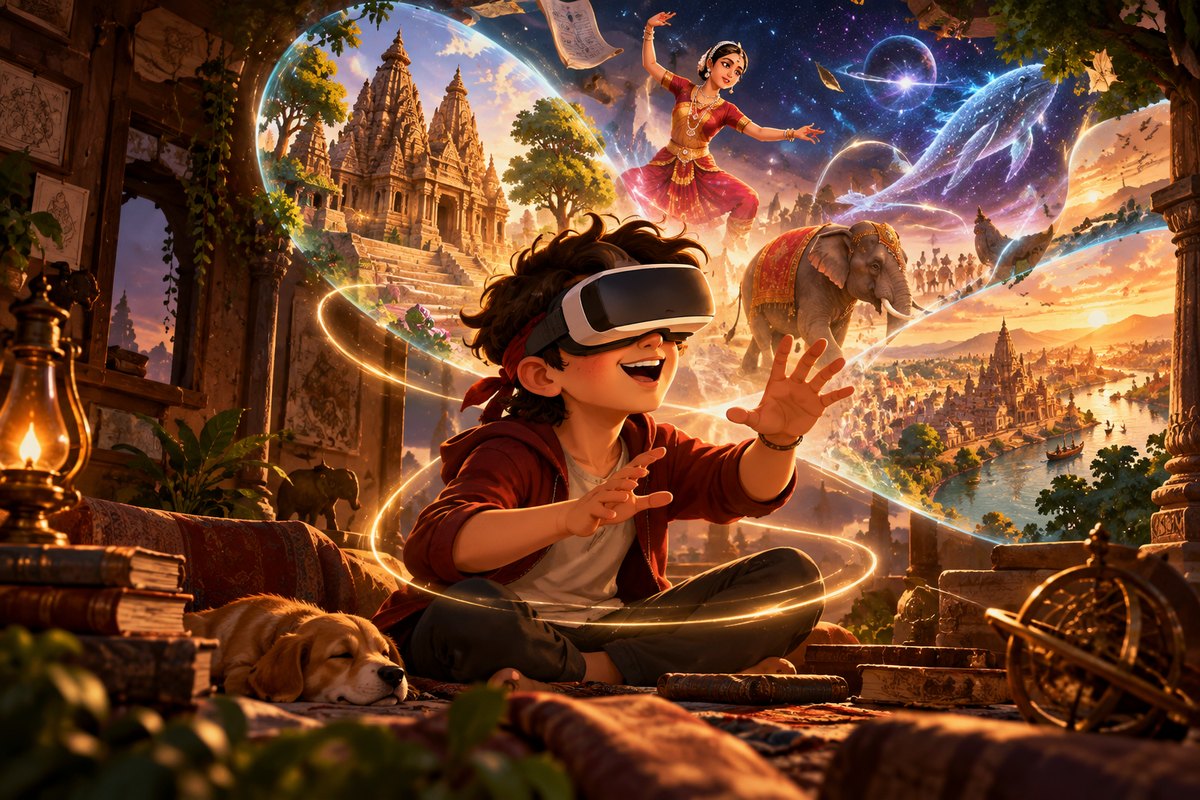
Curiosity begins through play and wonder.
Traditional knowledge has long been read, heard and watched. Vṛtam adds another layer: participation.
Vṛtam Studios makes India’s knowledge traditions experiential. Our name draws from Ṛtam, the Vedic principle of cosmic order and truth. Our traditions never left knowledge to information alone. They carried it through story, music, dance and ritual until learning became experience, and over time, intuition.
Through virtual reality spaces, augmented reality storybooks, walk-in immersive rooms and Kathakar, we carry that principle into technology. The aim is for these traditions to reach people in India and around the world the way they always intended, as experience.
The journey inwards
Every Vṛtam experience is built to move someone a little further along the same arc.
Curiosity begins through play and wonder.
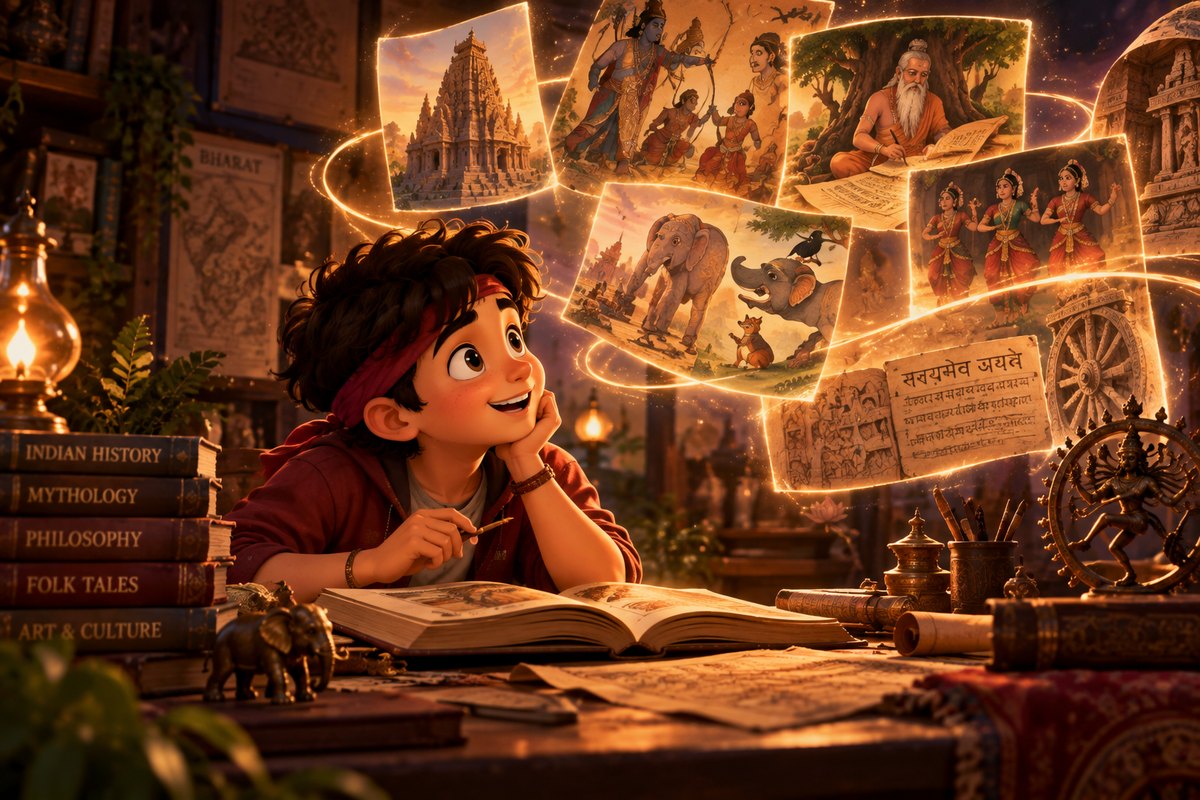
A deeper interest in our stories and roots emerges.
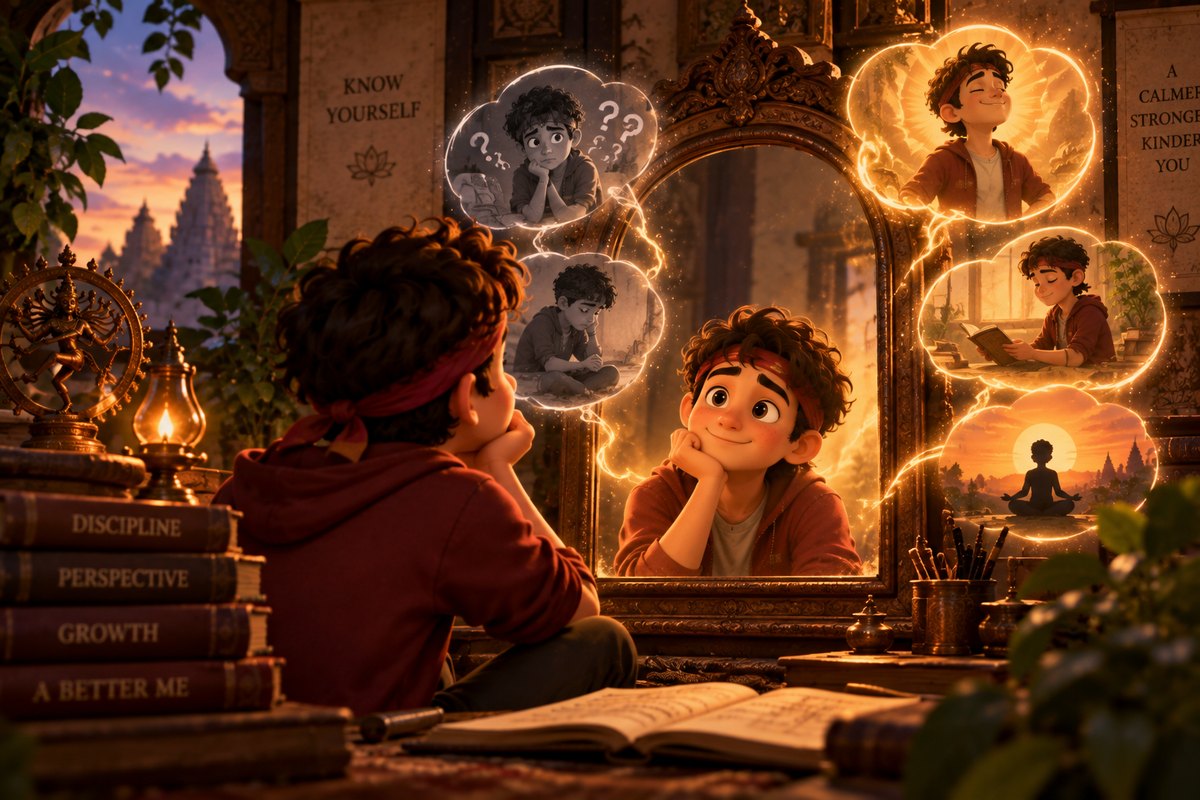
Attention turns from the story to the self.
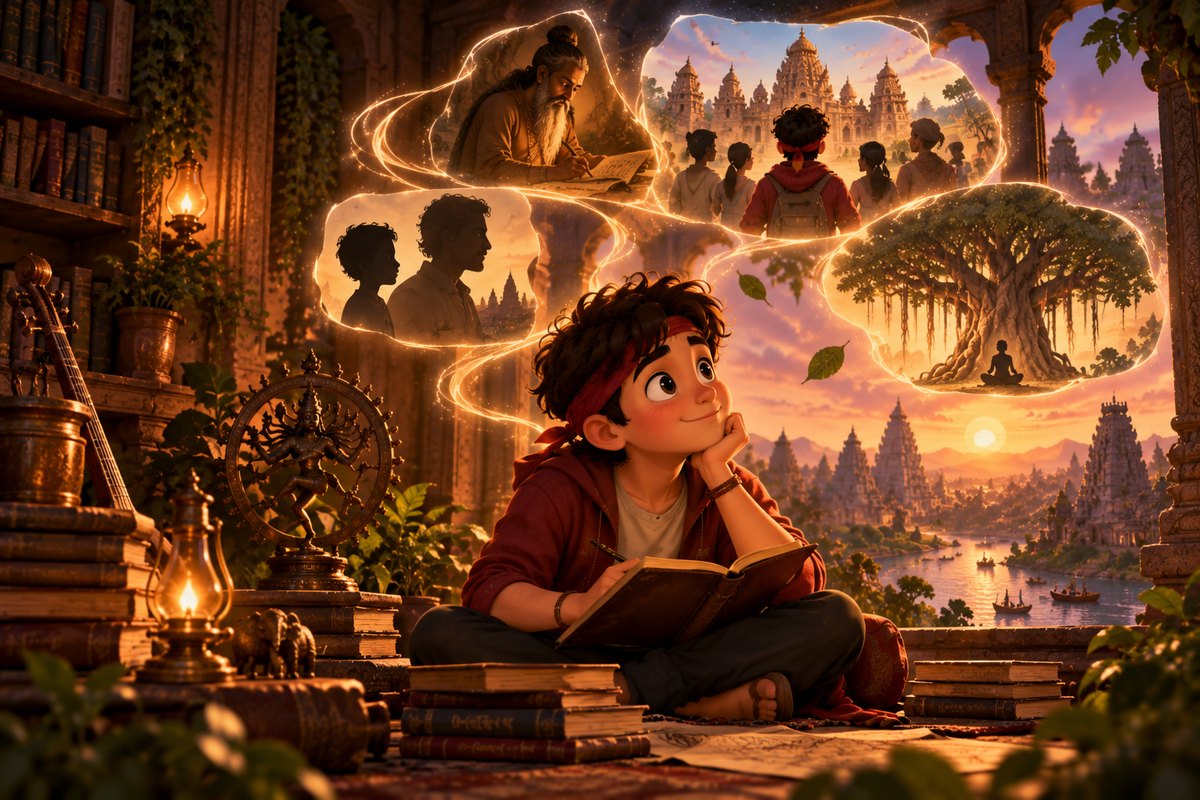
Understanding where one stands in a longer tradition.
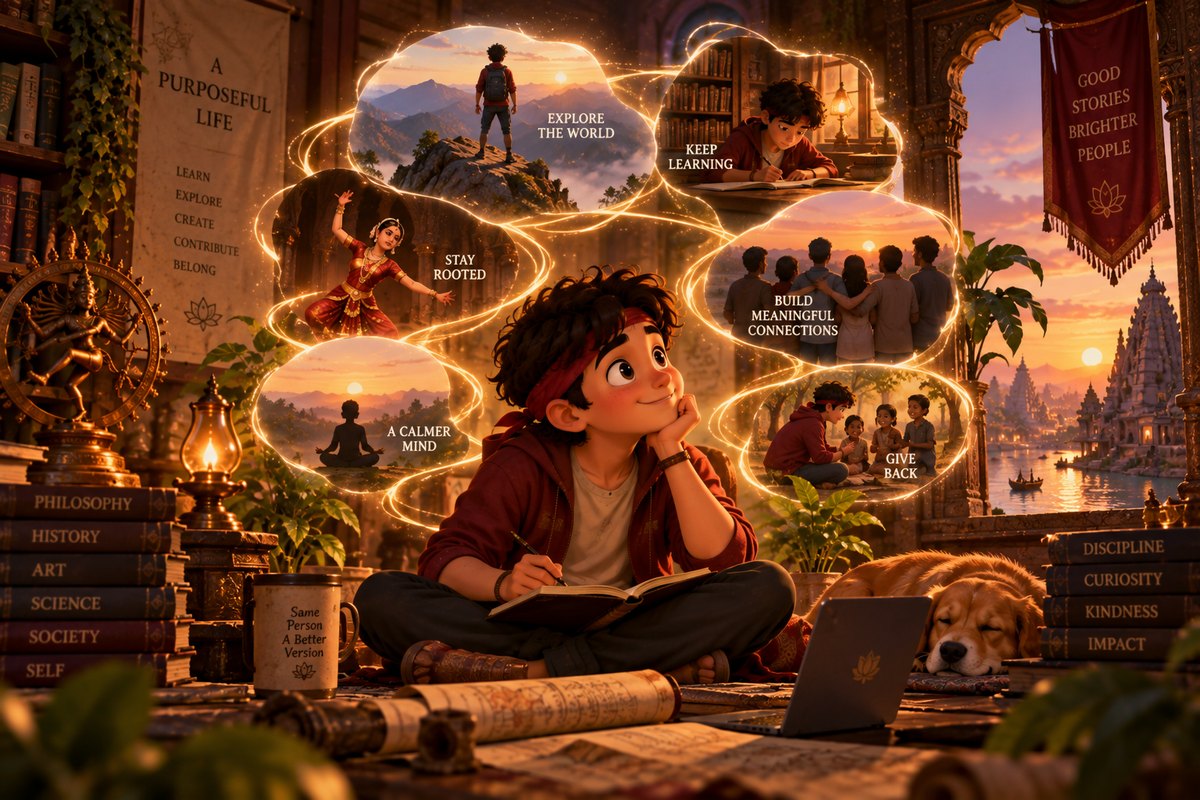
Knowledge carried into how one actually lives.
Voices
Feedback from authors, families, participants and creators who have encountered Vṛtam's work.
“The stories are handled with real care. Nothing is flattened to make it easier, and children still follow it completely. That balance is difficult to strike.
Ami Ganatra · Author
“Working with Vṛtam has been refreshingly practical. They understand the source material and they understand what actually holds a child’s attention.
TATTVAM
“Vṛtam builds for the tradition rather than around it. The craft is serious, and the intent behind the work is clear in the detail.
Bṛhat
“Our families responded immediately. Children who usually drift stayed with the session, and the parents wanted to know what was coming next.
Chinmaya Mission Austin
“They listened to the music before they drew anything. What came back carried the mood of the composition rather than sitting on top of it.
H.K. Venkatram · Musician
Media & milestones
Selected launches, recognition, talks and community moments.
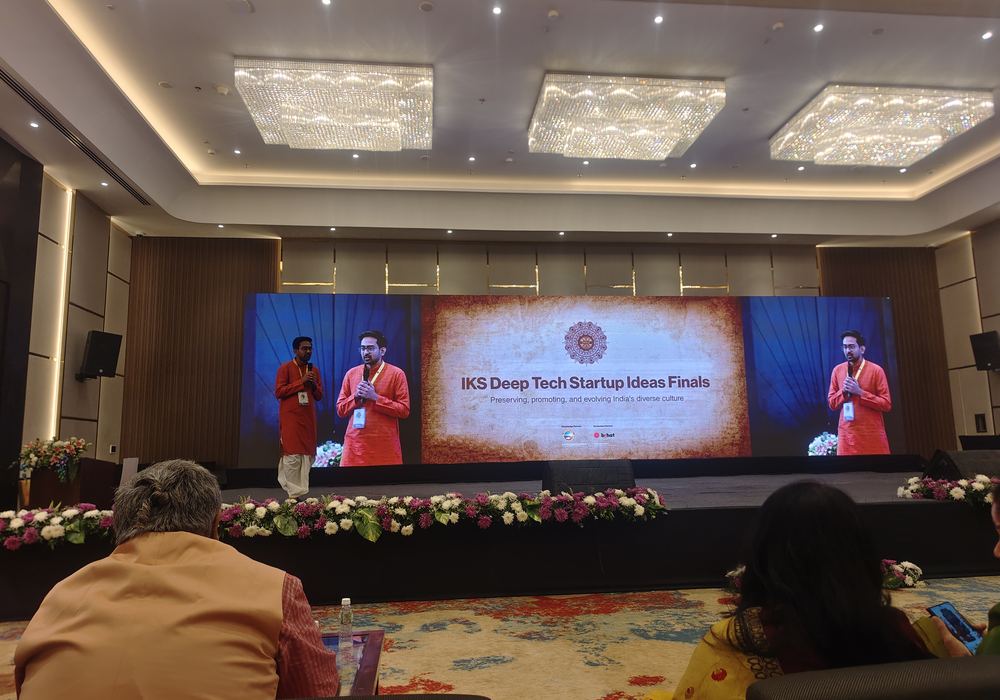
On stage
Pitching at the Adani Global Indology Conclave.
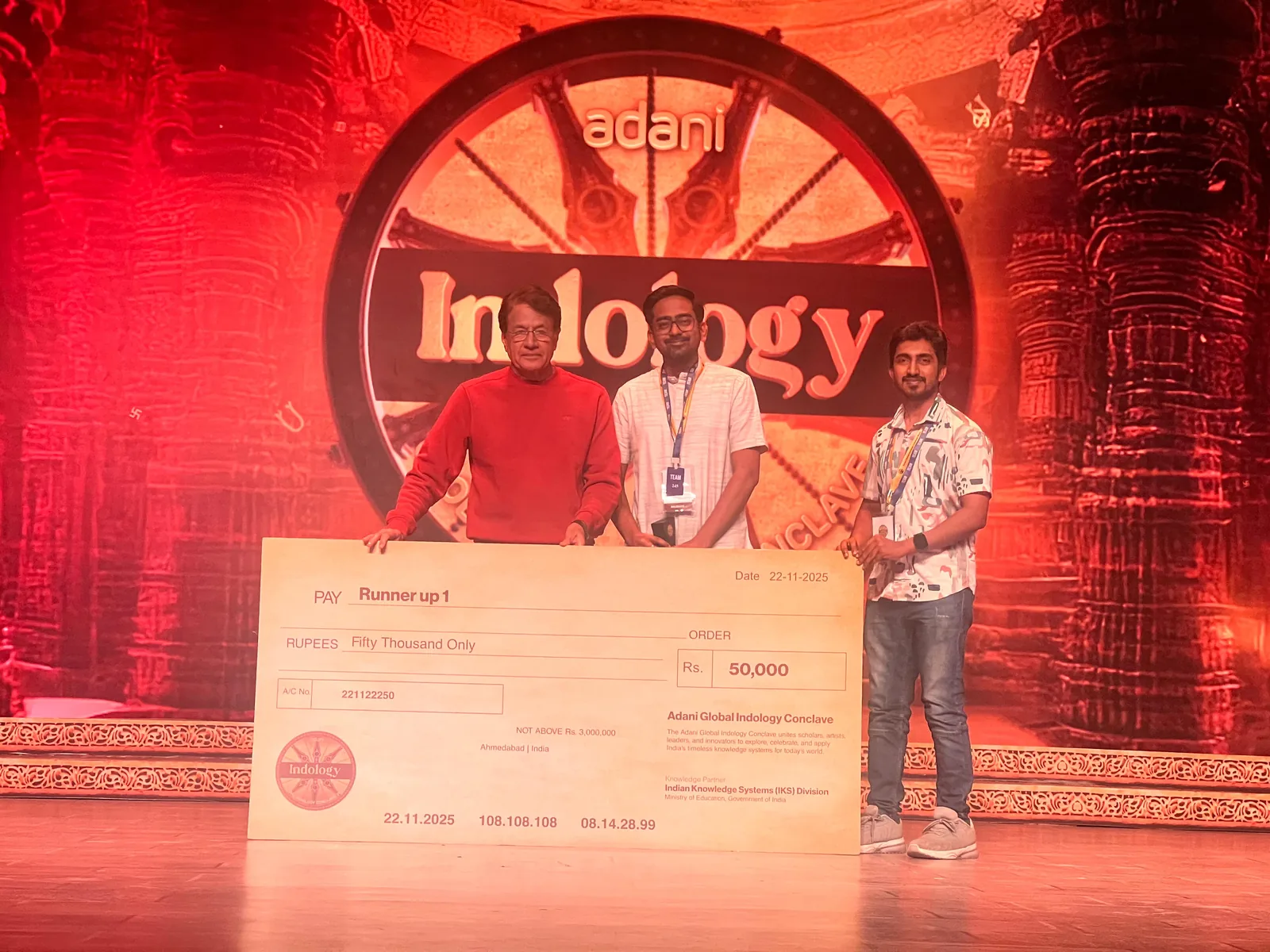
Recognition
Deep Tech runner-up.
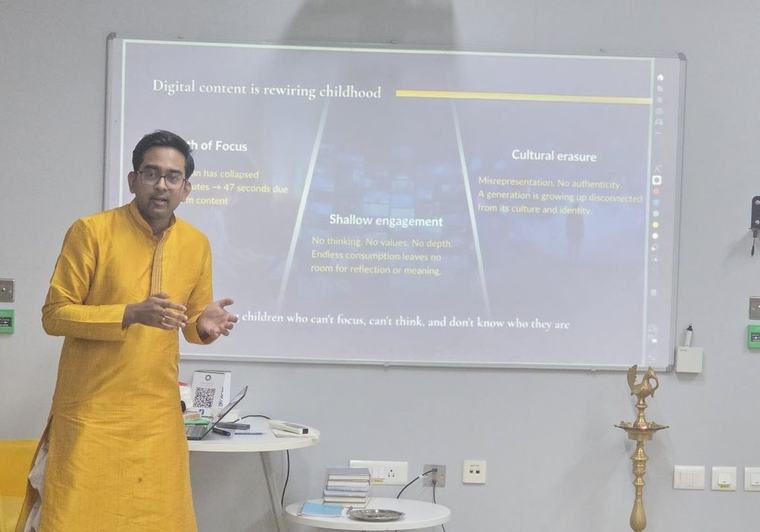
Talk
On digital content and childhood.
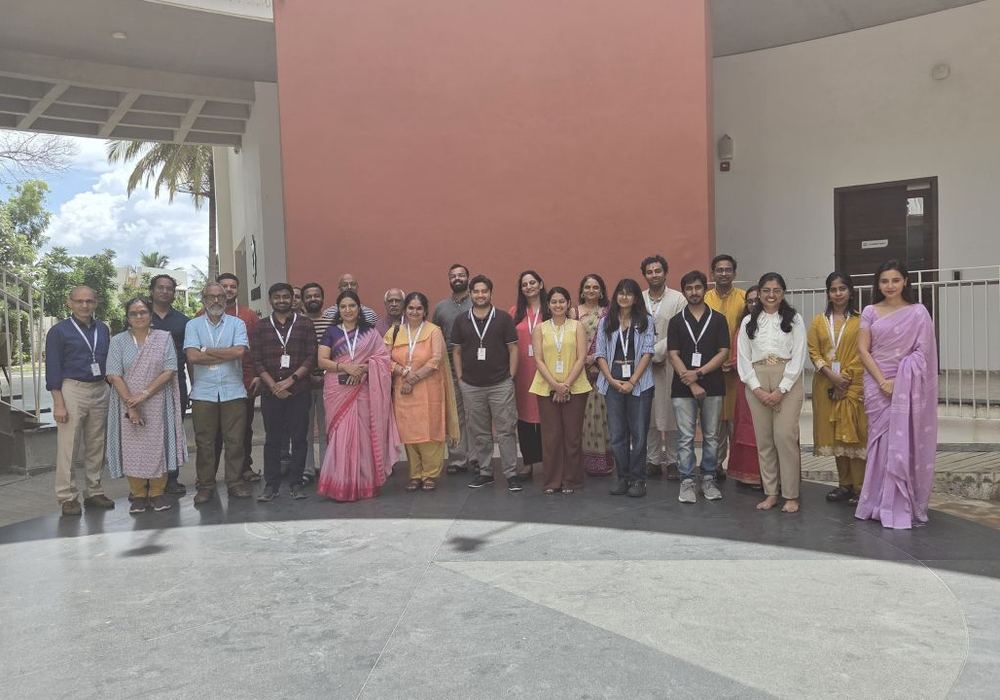
Community
Participants and organisers after the Bengaluru session.
Working with institutions
Vṛtam works with cultural, educational and community organizations to bring knowledge traditions into contemporary formats.
Work with Vṛtam
Tell us what you are exploring. We’ll take it from there.
Prefer email? [email protected]
We create immersive cultural experiences across virtual reality, augmented reality, room-scale environments and live stage performances.
What we create
The medium follows the story, the audience and the space.
Virtual Reality
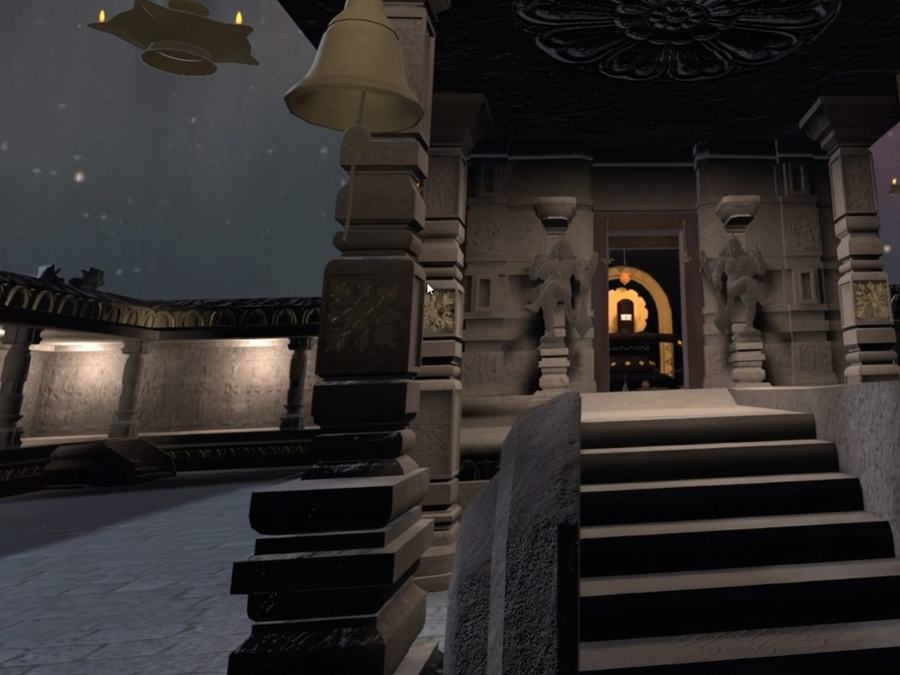
Immersive VR environments that let audiences encounter sacred spaces, stories and cultural worlds from within.
Build a VR experience →Augmented Reality
AR layers that bring books, objects and environments to life while keeping the real-world experience at the centre.
Explore AR →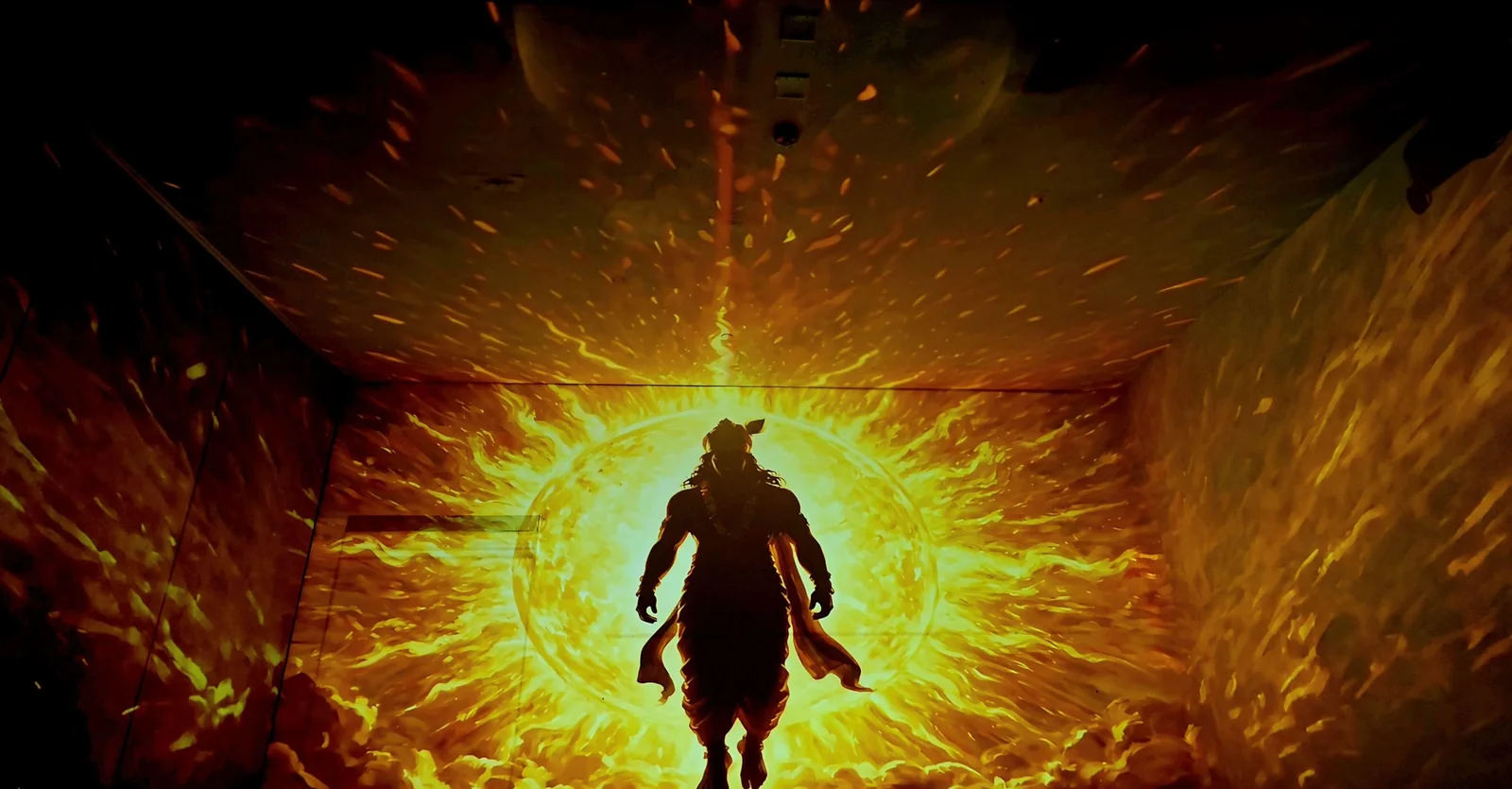
Room Scale
Projection, spatial sound and environmental storytelling designed for groups to experience together without a headset.
Commission an installation →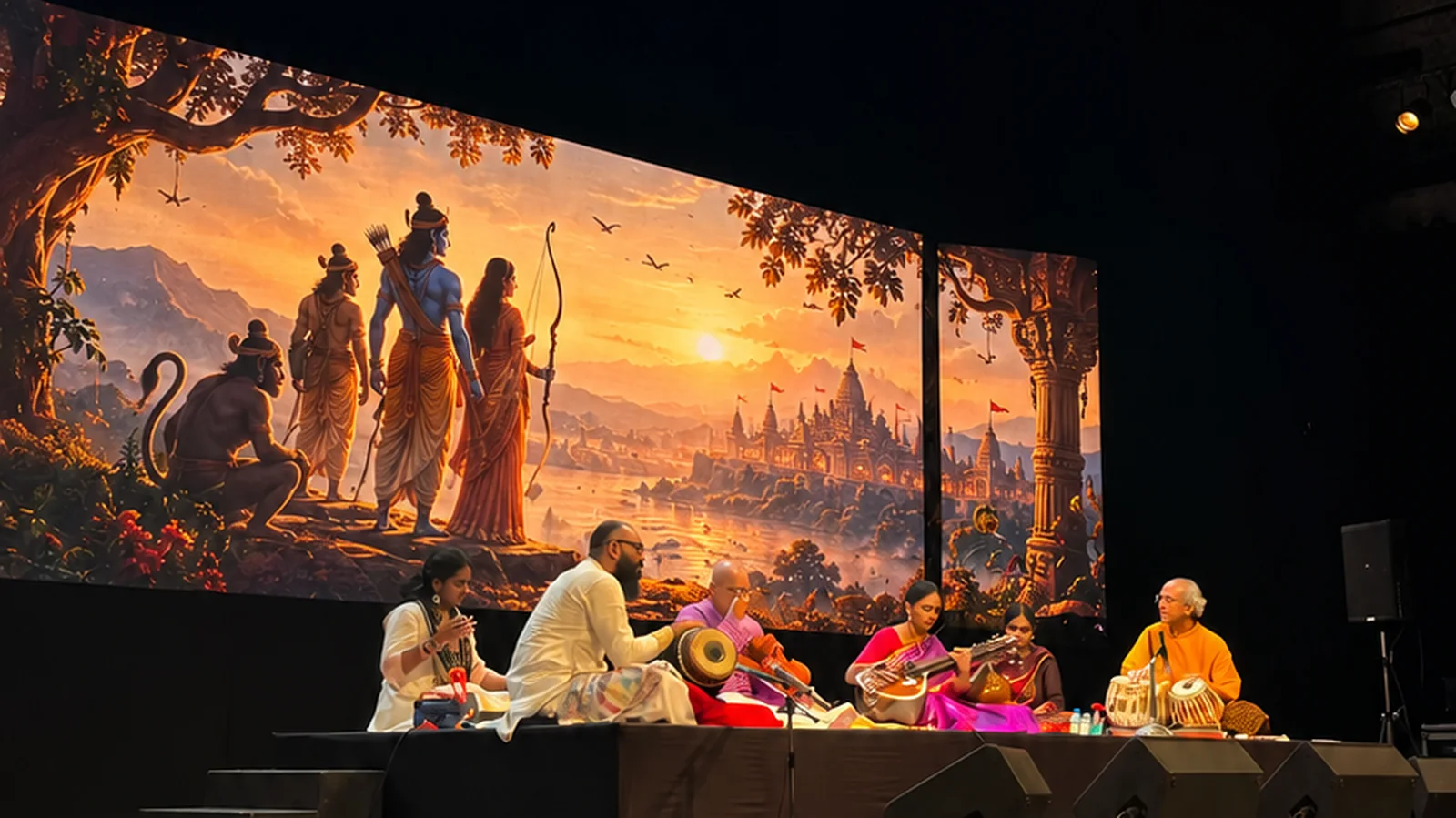
Live Stage Performances
Live experiences where narrative, performance, projected worlds and audience presence come together on stage.
Create a live experience →Selected work
Selected experiences across VR, room-scale environments and live performance.
Room Scale · Chinmaya Mission Austin
A fully immersive room experience created for Chinmaya Mission Austin’s Amrit Mahotsava. Visuals surround the audience across the walls and ceiling while spatial sound fills the room, transforming the space into Kurukṣetra and carrying audiences through key moments from the Gītā.
Virtual Reality
A contemplative VR journey into a sacred Shiva environment, designed around atmosphere, presence and a sense of encounter rather than passive viewing.
Virtual Reality
An immersive VR experience that lets audiences explore the sacred setting, architecture and atmosphere of Ayodhya and the Ram Mandir through a spatial digital world.
Live Stage Performance
A live musical experience combining performance, projected worlds and digital scenography to bring episodes from the Vālmīki Rāmāyaṇa to the stage.
Related reading
Work with Vṛtam
Augmented Reality is not just a visual novelty. It is a fundamentally new medium for storytelling. Here is how we are using it to resurrect the living tradition of Indian narrative.
Marshall McLuhan's famous dictum, "the medium is the message", is often used to argue that technology shapes culture. But the inverse is also true: culture shapes how technology is used, what stories it tells, and what kind of human beings it helps create.
At Vṛtam Studios, we are not using AR because it is new. We are using it because it is, in a surprising way, old. The tradition of immersive, multi-sensory storytelling in India, through temple sculpture, shadow puppetry, Yakṣagāna performances, Kāvaḍ storytelling boxes, was always about placing the audience inside the story. AR is a new tool for an ancient purpose.
Augmented Reality overlays digital content onto the physical world through a camera-equipped device. Unlike Virtual Reality, which replaces your environment entirely, AR adds to it. A child sitting at their table can hold up a phone and watch a forest materialise in their bedroom. A character can walk toward them, speak to them, react to their choices.
This is not a gimmick. The spatial presence created by AR, the sense that something is here in your space, activates a fundamentally different cognitive and emotional response than watching the same content on a flat screen. The content becomes proximate. And proximity changes everything in storytelling.
The Pañcatantra presented a specific design challenge: it is not a single story but a nested, recursive structure. Stories contain stories contain stories. The outermost frame, Viṣṇu Śarma teaching the princes through animal fable, sets the terms for everything within it.
Our approach was to work from the outside in: establish the world first, then reveal the stories within it.
In traditional Pañcatantra illustrations, the forest is everything. It is where power operates without law, where intelligence is the only advantage, where alliances shift and enmities endure. We designed the AR experience space as a forest: not a static backdrop, but a living environment that responds to the user's presence.
The forest rustles. Animals move at the periphery. The density of the canopy shifts with the narrative tension. The world is not decoration. It is the primary carrier of meaning.
One of the core principles of our character design is that each animal in the Pañcatantra must carry their entire symbolic tradition. The crow is intelligent and adaptable. The lion is powerful but susceptible to flattery. The jackal is clever but motivated by envy. The tortoise is patient and wise but can be undone by carelessness.
In the AR experience, these characters do not simply appear and speak. They behave. The lion moves with the unhurried authority of someone accustomed to being obeyed. The jackal is always slightly too eager, slightly too close. The crow observes from a distance before committing.
Character behaviour is where meaning lives in a story. We spent more time on this than any other design element.
The Pañcatantra was an oral tradition before it was a written one. The sound design of our AR experience reflects this. We worked with classical Carnatic musicians and Sanskrit scholars to develop a sonic palette that is rooted in the tradition, not in Hollywood fantasy scoring, which would be the easy path.
The background texture uses drone-based compositions built around the Sa and Pa of the relevant rāga for each narrative arc. Character voices are performed by trained artists who understand the Sanskrit sources. Nothing is generated.
Building AR experiences that work reliably across consumer devices requires solving several layers of technical problems simultaneously.
The experience needs to understand the physical surface in front of the user, its size, orientation and stability, and anchor content to it in a way that holds even as the device moves. We use markerless tracking, which means the experience can unfold on any table, floor, or open surface without requiring a printed trigger image.
Mobile devices have strict constraints on polygon count, texture memory, and draw calls. Every character model in our experience is carefully optimised: high-fidelity from the user's typical viewing distance, with detail reduced aggressively at distance. We use a custom LOD (Level of Detail) system that transitions invisibly.
An interactive story is a graph, not a line. The narrative engine we built tracks the user's choices and maintains story state across a session: who has been spoken to, what has been revealed, which moral question is currently active. This state must be preserved even if the user puts down their device and returns later.
We are sometimes asked whether AR storytelling is "just" entertainment, whether it is serious enough for education, for cultural preservation, for the transmission of deep tradition.
The question assumes a distinction that the Pañcatantra itself refuses to make. For Viṣṇu Śarma, entertainment was the vehicle for education. The princes learned because they were captivated. They were captivated because the stories were brilliantly constructed. The wisdom and the delight were not separable.
What we are building is not educational content with an AR wrapper. It is an immersive world in which wisdom is implicit: in the behaviour of the characters, in the consequences of choices, in the visual and sonic language of the tradition.
A child who has spent an hour in this world will not have memorised a list of moral principles. They will have encountered them. The Pañcatantra asks for nothing more.
The Pañcatantra is our first release, but it is not our only ambition. The same framework, immersive, interactive, rooted in Indian Knowledge Systems and designed for embodied learning, applies across the full range of Dhārmic narrative tradition.
The Mahābhārata. The Rāmāyaṇa. The Upaniṣadic dialogues. The Jātaka tales. The stories of the Bhakti saints. Each of these contains a world-class narrative tradition that has never been experienced in immersive form.
That is the work we are here to do.
Work with Vṛtam
We turn Indian knowledge traditions into products, learning experiences and immersive worlds.
 Launch
Vṛtam Studios Launches at Swarajya Conclave
Recognition
Vṛtam Named Deep Tech First Runner-Up at Adani Global Indology Conclave
 Partnership
Vṛtam Signs MoU with Tatva Academy US
 Partnership
Vṛtam Partners with Bṛhat
 Event
Vṛtam at Aucitya: Rasa and Bhāva in Product Design
 Partnership
Vṛtam Signs MoU with Chinmaya Mission Austin
 Product
Introducing Vṛtam Stories: Panchatantra & Tenali Rama
 Platform
Introducing Kathakar: Vṛtam’s Platform for Indian Knowledge Traditions
Explore Indian knowledge traditions through Vṛtam Stories and Kathakar sessions.
Use Kathakar to host live sessions and build communities around the knowledge you share.
Use Kathakar and Vṛtam’s services to turn Indian knowledge traditions into engaging experiences for your audience.
“The stories are handled with real care. Nothing is flattened to make it easier, and children still follow it completely. That balance is difficult to strike.
Ami Ganatra · Author
“Working with Vṛtam has been refreshingly practical. They understand the source material and they understand what actually holds a child’s attention.
TATTVAM
“Vṛtam builds for the tradition rather than around it. The craft is serious, and the intent behind the work is clear in the detail.
Bṛhat
“Our families responded immediately. Children who usually drift stayed with the session, and the parents wanted to know what was coming next.
Chinmaya Mission Austin
“They listened to the music before they drew anything. What came back carried the mood of the composition rather than sitting on top of it.
H.K. Venkatram · Musician
 BṛhatChinmaya Mission Austin
 Gurukula.comTatva Academy US
 Tattvam Media
 Vijaya College of Music
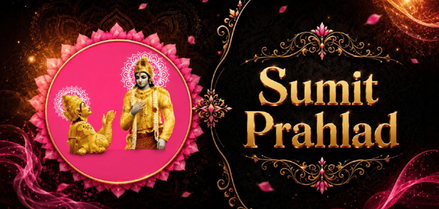 Sumit Prahlad (e‑Gita)
Three revenue surfaces already in market or in pilot, with public recognition behind them.
Recognition
Adani Global Indology Conclave.
Launch
Public launch on Guru Pūrṇimā.
Reach
Three surfaces, one studio.
Opens an email. Connect a form service before launch.
Work with Vṛtam
Launches, collaborations, recognition, products and moments from the journey.
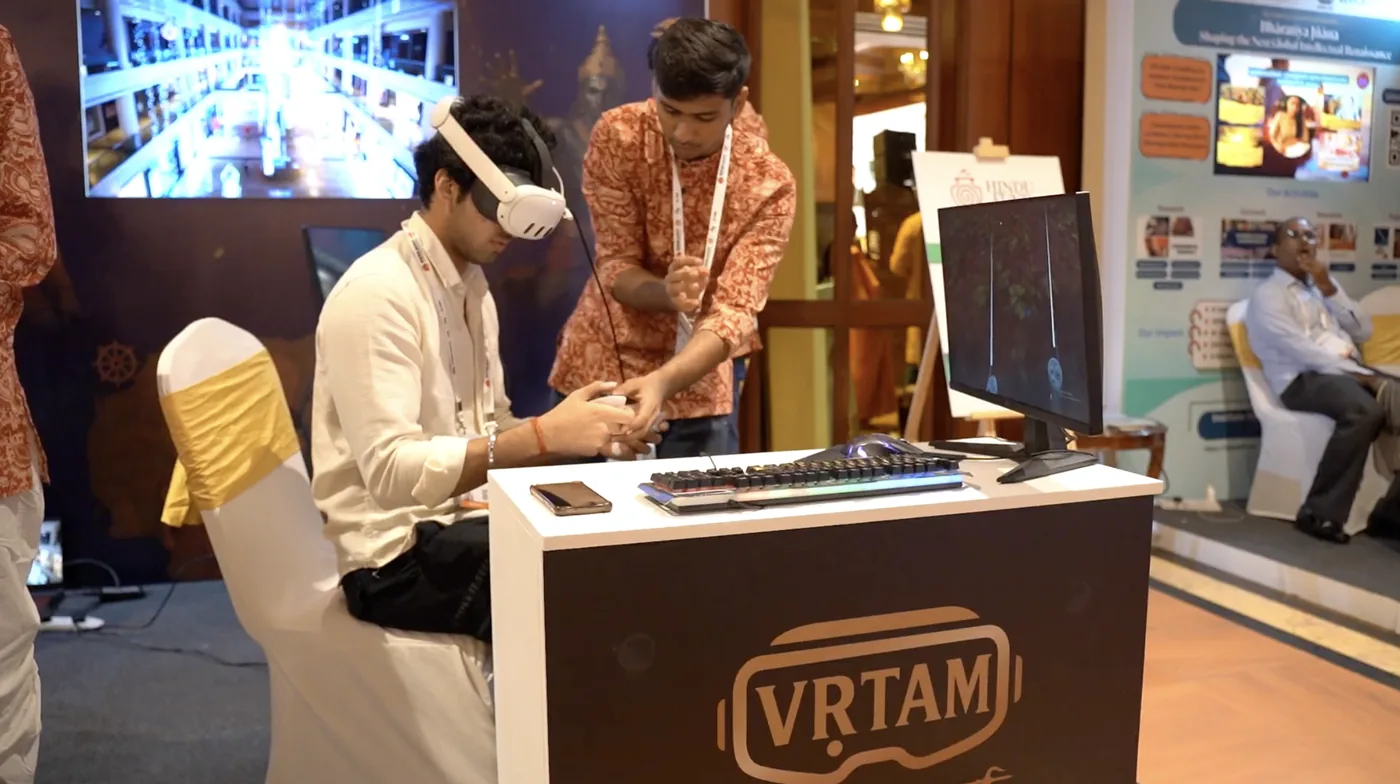
Vṛtam officially launches at Swarajya Conclave 2025 in New Delhi, bringing our AR, VR and experiential storytelling work to a live audience for the first time.
Read announcement →RecognitionVṛtam is recognized as First Runner-Up in the Deep Tech Startup category at the inaugural Adani Global Indology Conclave in Ahmedabad.
Read announcement →PartnershipA new framework to explore experiential learning, cultural programmes, interactive content and community engagement together.
Read announcement →CollaborationVṛtam and Bṛhat come together around a shared interest in contemporary ways for Indian knowledge systems to reach and shape new audiences.
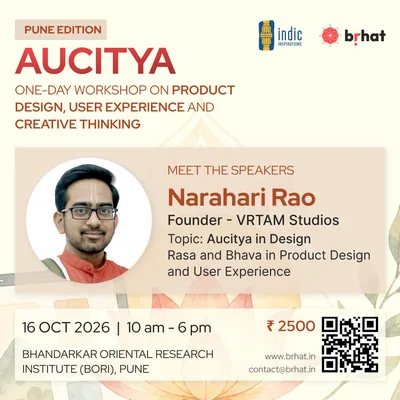
Read announcement →EventVṛtam joins Aucitya Pune to explore how Indian aesthetic frameworks can inform product design, user experience and creative thinking.
Read announcement →PartnershipThe collaboration creates a framework around Indian knowledge traditions, learning and immersive experiences, beginning with an immersive Bhagavad Gītā experience.
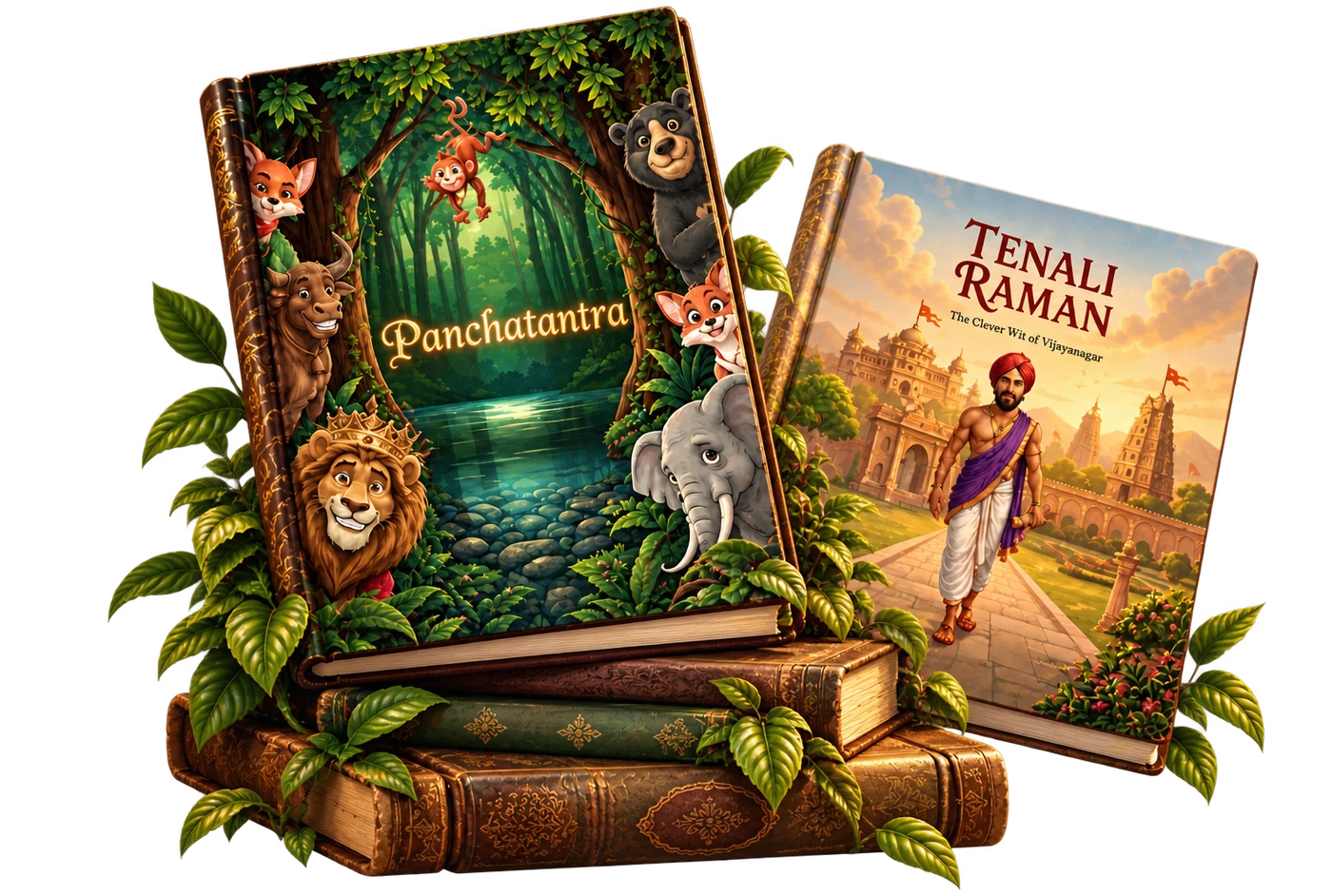
Read announcement →ProductOur first two Vṛtam Stories titles bring Panchatantra and Tenali Rama into illustrated physical books enhanced with augmented reality.
Read announcement →PlatformKathakar is built for creators, educators and institutions who want to teach, gather audiences and grow communities around the knowledge they share.
Read announcement →Ideas behind the work
Vṛtam officially launches at Swarajya Conclave 2025 in New Delhi, bringing our AR, VR and experiential storytelling work to a live audience for the first time.
Vṛtam Studios officially launched at Swarajya Conclave 2025 in New Delhi, bringing our work in AR, VR and experiential storytelling to a live audience for the first time.
The conclave brought together leaders, scholars, investors and policymakers around questions of Bharat’s civilisational future, with themes spanning Dharma, cultural identity, manuscripts, innovation and India @2047. It was held at The Ashok, New Delhi, and featured voices including Union Culture Minister Gajendra Singh Shekhawat, Sanjeev Sanyal and Ami Ganatra.
For Vṛtam, the most memorable part was watching people step into the experiences themselves. Hundreds of visitors explored our AR and VR work, many encountering this form of cultural storytelling for the first time.
The response reinforced the idea that led us here: Indian knowledge traditions can remain rooted in their source while finding powerful new forms for a new generation.
The launch also opened conversations with institutions, creators and partners interested in building with Vṛtam.
Vṛtam is recognized as First Runner-Up in the Deep Tech Startup category at the inaugural Adani Global Indology Conclave in Ahmedabad.
Vṛtam Studios was recognized as First Runner-Up in the Deep Tech Startup category at the inaugural Adani Global Indology Conclave in Ahmedabad.
The conclave, hosted by the Adani Group in collaboration with the Ministry of Education’s Indian Knowledge Systems division, brought together scholars, technologists and institutions working on the future of India’s civilisational knowledge. During the conclave, Gautam Adani announced a ₹100 crore founding contribution toward the Bharat Knowledge Graph and related work in knowledge preservation, research and technology.
For Vṛtam, this recognition is especially meaningful because our work sits at the intersection of those same worlds: cultural knowledge, technology and experience.
We believe the coming decade offers an unusual opportunity to build technology that understands Indian knowledge traditions from within their own context. Our work across products, platforms and immersive experiences is one part of that larger journey.
A new framework to explore experiential learning, cultural programmes, interactive content and community engagement together.
Vṛtam Studios has signed a Memorandum of Understanding with Tatva Academy US to explore new ways of bringing Indian knowledge traditions to learners through technology and experience.
The collaboration creates a framework for Vṛtam and Tatva Academy to work together across experiential learning, cultural programmes, interactive content and community engagement.
For Vṛtam, partnerships like this are important because meaningful cultural learning rarely begins with technology alone. It begins with trusted knowledge, thoughtful teaching and an understanding of the learner. Technology can then give that knowledge new forms.
Together, the two organizations will explore experiences that combine Tatva Academy’s educational work with Vṛtam’s capabilities across interactive products, immersive technology and live learning.
The MoU marks another step toward building an ecosystem where institutions can use contemporary formats while remaining rooted in the knowledge they seek to share.
Vṛtam and Bṛhat come together around a shared interest in contemporary ways for Indian knowledge systems to reach and shape new audiences.
Vṛtam Studios and Bṛhat are coming together around a shared interest: finding contemporary ways for Indian knowledge systems to reach, engage and shape new audiences.
Bṛhat describes itself as a culture engine for Indian Knowledge Systems, working across education, creative practice and design rooted in Indian civilisational consciousness.
The collaboration brings together Bṛhat’s knowledge ecosystem with Vṛtam’s work across experiential products, immersive storytelling and the Kathakar platform.
We see strong possibilities around live learning, creator communities, cultural experiences and new formats through which knowledge can move from scholarship into participation.
More details on the collaboration will be shared as the work takes shape.
Vṛtam joins Aucitya Pune to explore how Indian aesthetic frameworks can inform product design, user experience and creative thinking.
Vṛtam will be part of Aucitya Pune, a one-day workshop by Bṛhat exploring how Indian aesthetic frameworks can inform contemporary product design, user experience and creative thinking.
The programme is built around Aucitya, the discernment of what is appropriate to context, purpose, people, place and time. Bṛhat frames the idea through the relationship between Satya, Saundarya and Dharma, extending it into design, communication, education and institutional thinking.
Representing Vṛtam, founder Narahari Rao will lead a session on Rasa and Bhāva in Product Design and User Experience, exploring questions such as whether digital interactions can evoke rasa, how aesthetics shape trust and behaviour, and what makes an experience meaningful and memorable.
This thinking is closely connected to how we build at Vṛtam: beginning with the meaning and emotional quality of an experience, then choosing the technology that serves it.
The collaboration creates a framework around Indian knowledge traditions, learning and immersive experiences, beginning with an immersive Bhagavad Gītā experience.
Vṛtam Studios has signed a Memorandum of Understanding with Chinmaya Mission Austin, creating a framework for collaboration around Indian knowledge traditions, learning and immersive experiences.
One of the first projects emerging from this relationship is an immersive Bhagavad Gītā experience being designed for Chinmaya Mission Austin’s Amrit Mahotsava.
The experience takes audiences into the setting of Kurukṣetra through a room-scale visual environment and uses narrative, sound and spatial storytelling to introduce key moments from the Gītā in a form that can be experienced together.
The broader collaboration also creates opportunities to explore Kathakar, Vṛtam products and future experiential programmes with the Chinmaya community.
For us, this is an important example of what institutional collaboration can look like: authentic source material, trusted community context and technology working together to create a new way of encountering timeless knowledge.
Our first two Vṛtam Stories titles bring Panchatantra and Tenali Rama into illustrated physical books enhanced with augmented reality.
We created Vṛtam Stories to give timeless Indian stories a new experiential form.
Our first two titles bring the worlds of Panchatantra and Tenali Rama into illustrated physical books enhanced with augmented reality.
The experience begins with the book itself. Readers can then use the Vṛtam app to discover additional layers where characters, scenes and moments from the story come alive.
The intention is simple: keep the tactile experience of reading while allowing technology to deepen curiosity and participation.
Panchatantra and Tenali Rama are the beginning of a larger story world we want to build around Indian narratives, wisdom traditions and characters that generations of families have grown up with.
For children, the experience begins with wonder. For families, it creates another way to discover and share these stories together.
Kathakar is built for creators, educators and institutions who want to teach, gather audiences and grow communities around the knowledge they share.
Vṛtam Studios has launched Kathakar, a platform where Indian knowledge traditions become experiences.
Kathakar is built for creators, educators and institutions who want to teach, gather audiences and grow communities around the knowledge they share.
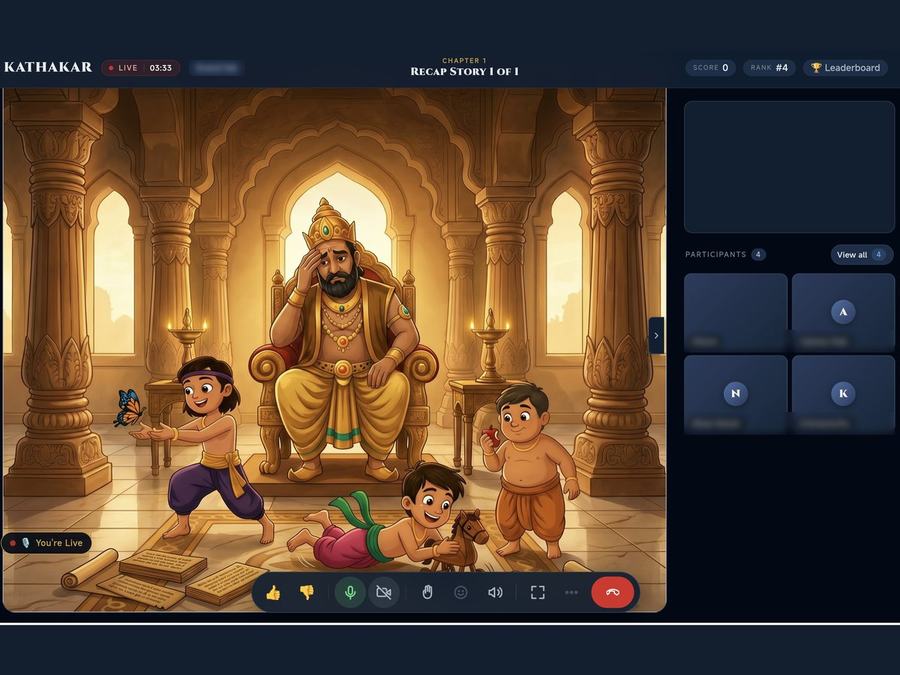
A creator can design and host live sessions, engage participants through interactive moments, and continue the relationship through dedicated communities. Multiple communities can be created around different subjects, teachers or interests, giving creators and institutions a persistent home for their audiences.
As those communities grow, they can strengthen creator identity, improve repeat participation and support future workshops, courses, events and other paid programmes.
Kathakar brings this journey together in one place:
Create. Run. Engage. Grow.
Our aim is to help Indian knowledge move beyond passive consumption and become something people can participate in, return to and build community around.
Writing on storytelling, symbolism, language, cultural memory and the role of technology in how knowledge is carried forward.
Augmented Reality is not just a visual novelty. It is a fundamentally new medium for storytelling. Here is how we are using it to resurrect the living tradition of Indian narrative.
Experiential pedagogy is the idea that the deepest learning happens not through instruction but through direct encounter. It has roots going back thousands of years, and modern neuroscience is finally catching up.
Written over two thousand years ago, the Pañcatantra remains one of humanity's most enduring story collections. Here's why it resonates as powerfully today as it did then.
Nothing filed under that topic yet.
Work with Vṛtam
A platform to learn, teach, gather and grow your community.
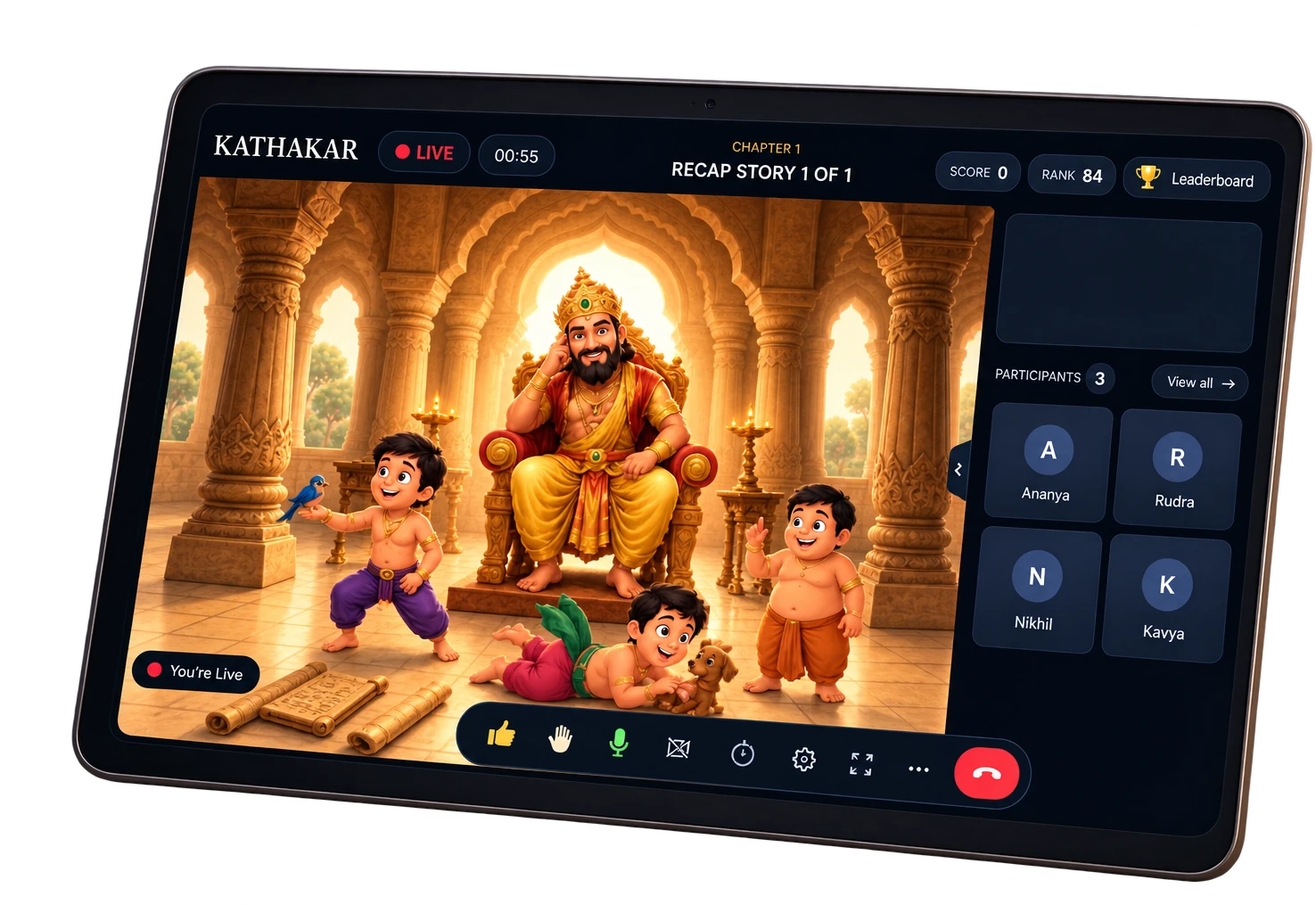
For creators
Host storytelling, discourse and workshops that give people a reason to participate, return and stay connected around your work.
For educators
Bring questions, discussion and live interaction into the lesson, then carry the group forward across a series rather than starting over each time.
For institutions
Run recurring sessions across hosts and cohorts while giving participants a shared place to keep gathering around the institution’s knowledge programs.
A session, end to end
Kathakar is built around participation in the moment and continuity afterwards. A live room can become a group that returns, learns and grows together.
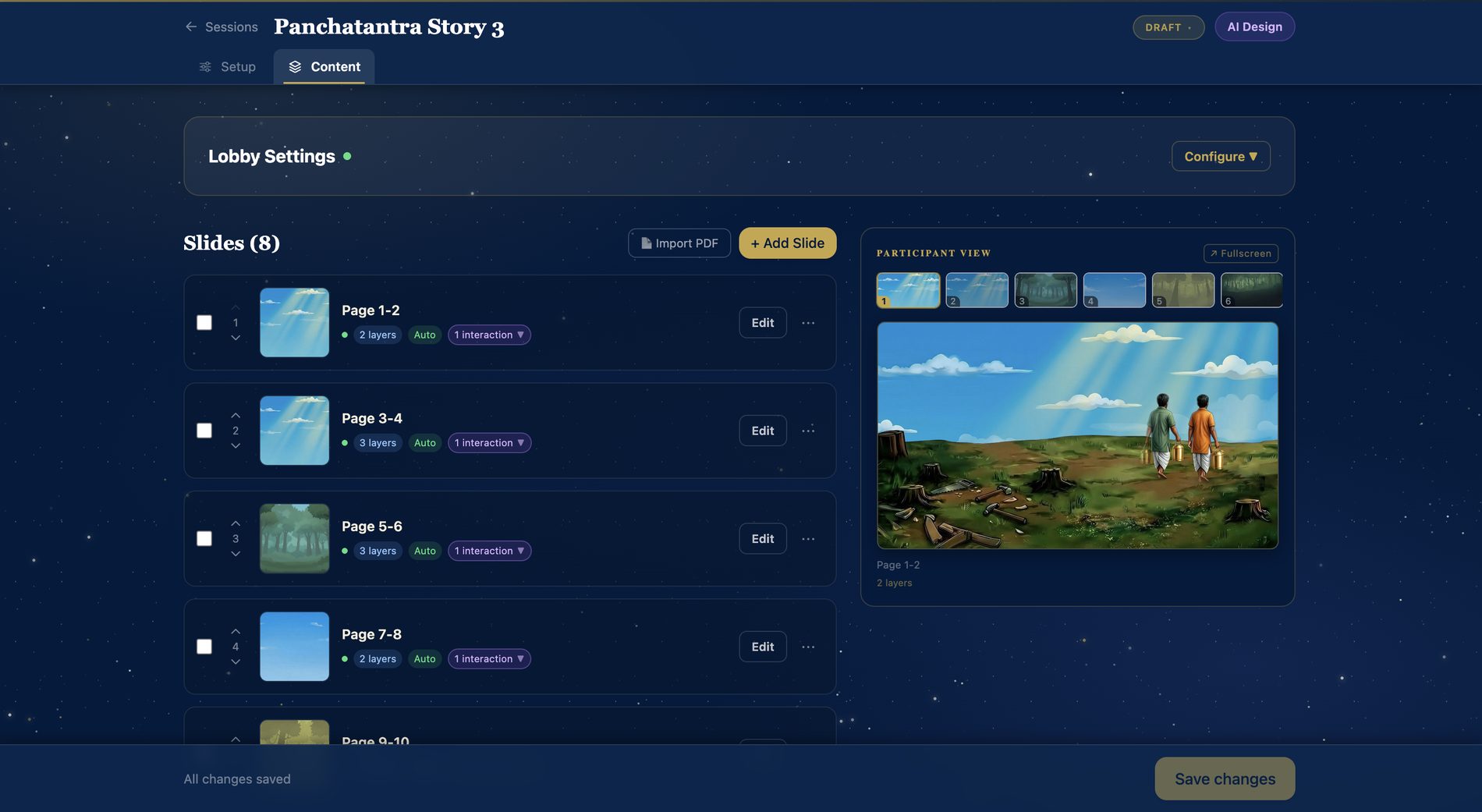
Choose the chapter, the assets and the flow before you go live.
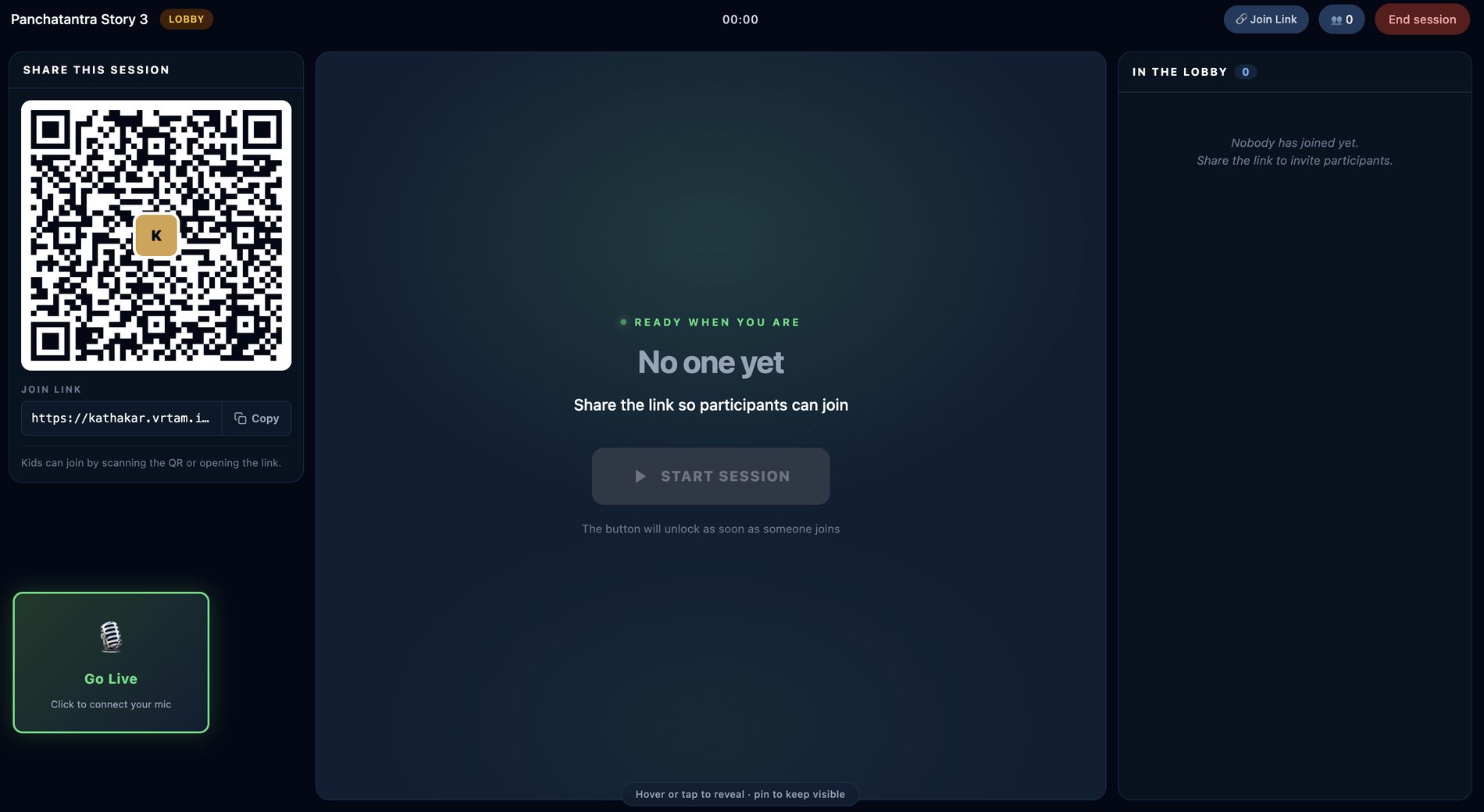
Participants join with a link. No install, no account friction.
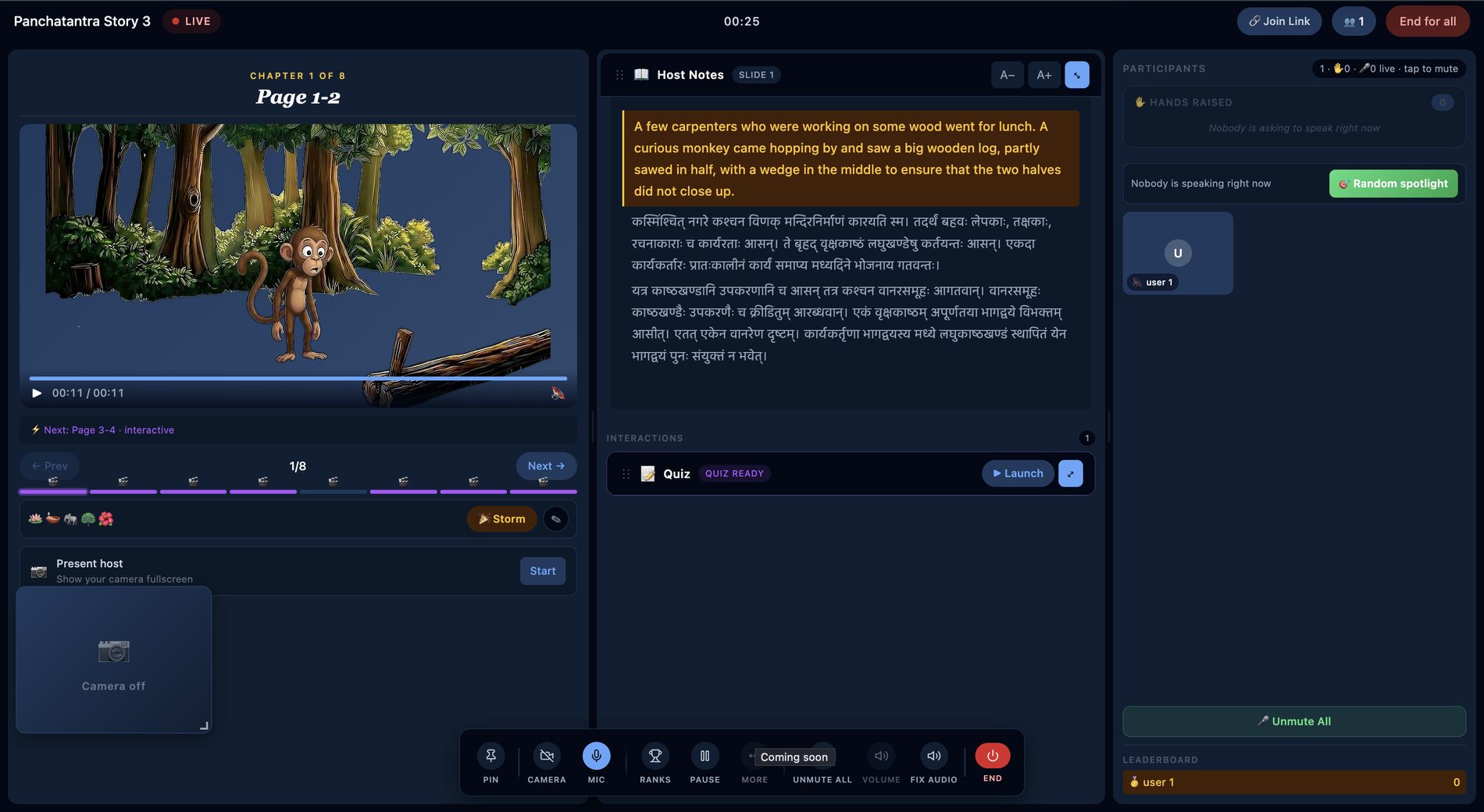
Narrate over illustrated scenes, with your voice and face in the room.
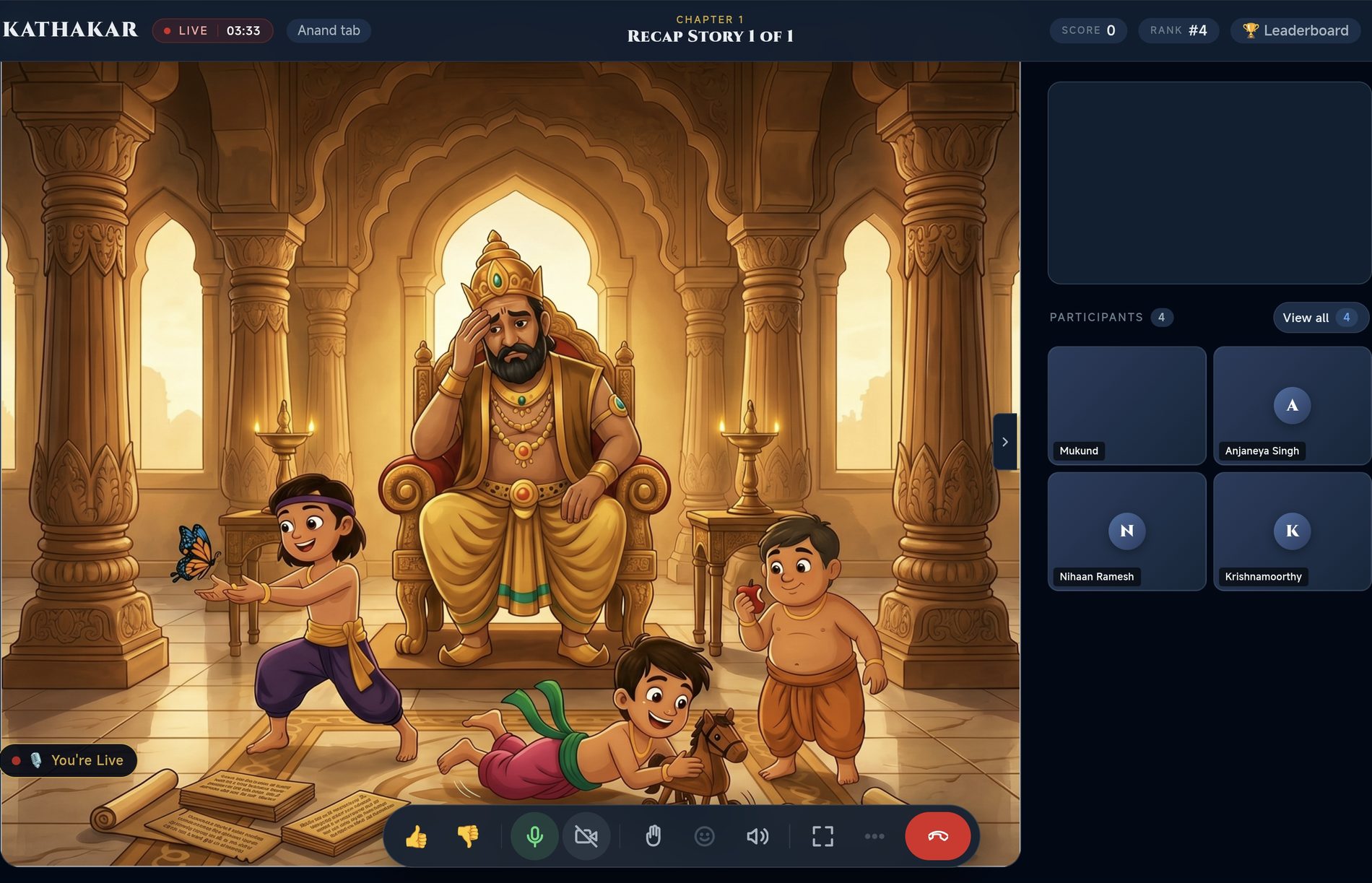
Everyone is named, scored and present, not a list of silent viewers.
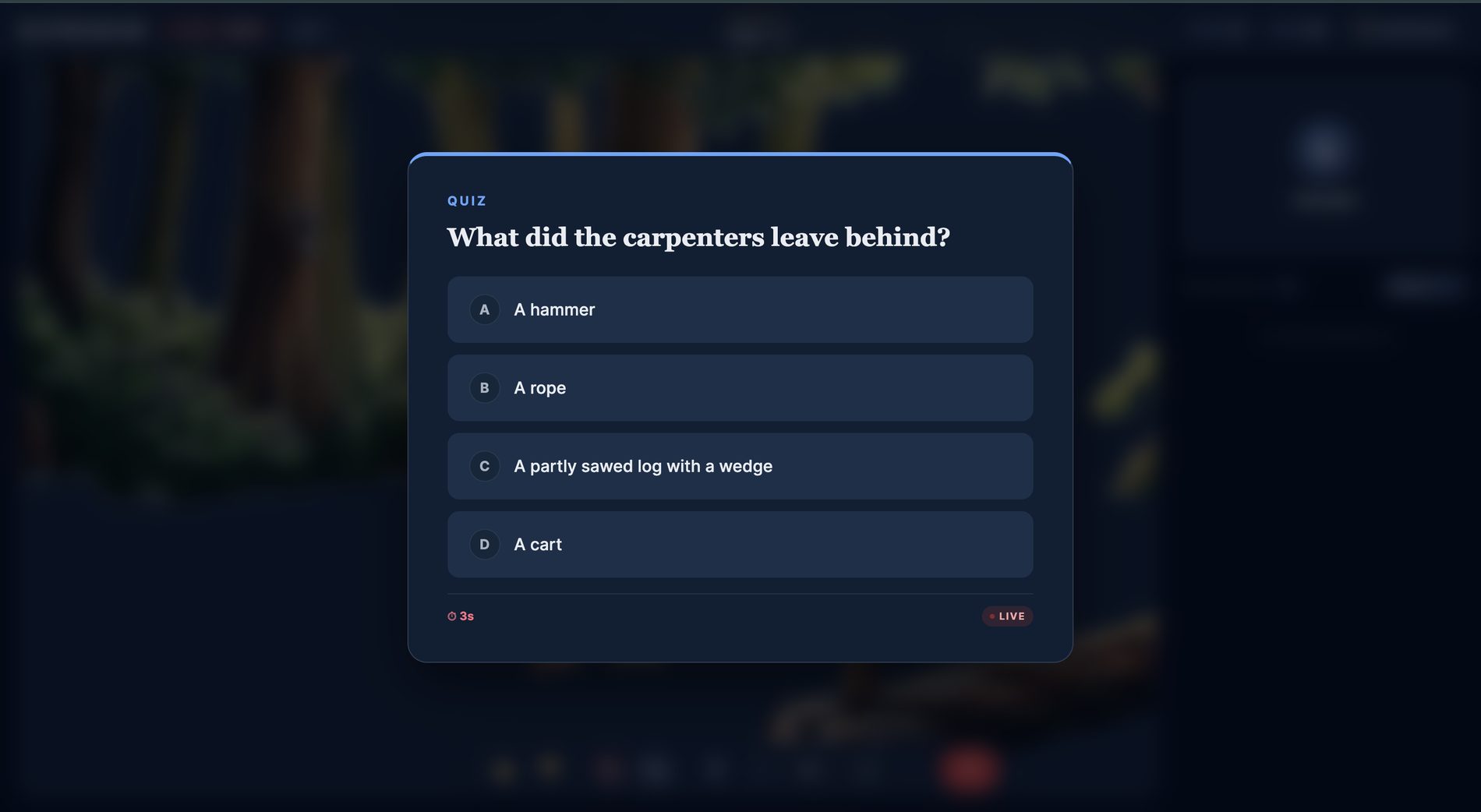
Questions, scoring and reactions turn listeners into participants.
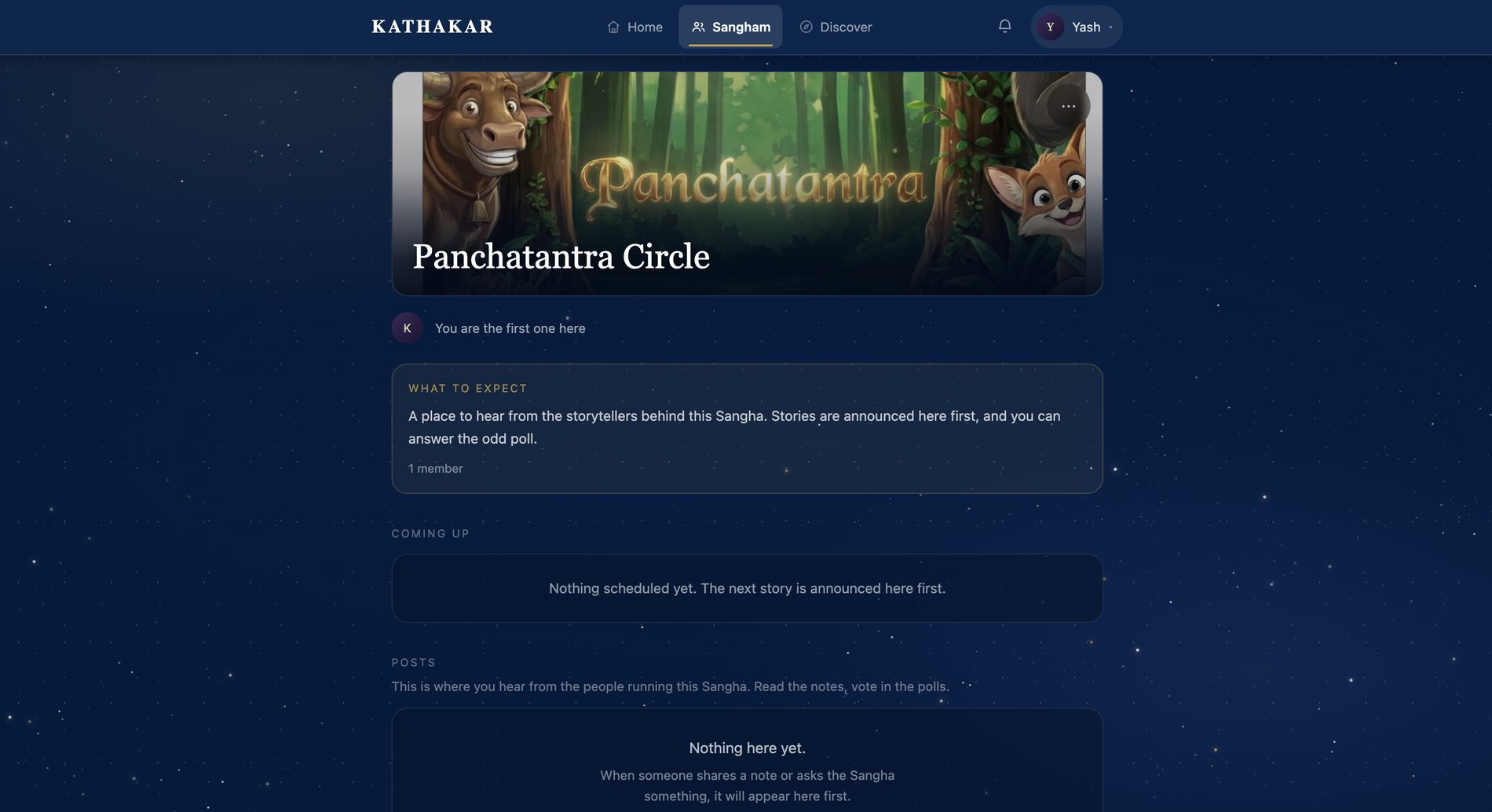
The room does not disappear when the session ends. Bring the same people back for the next story, class or conversation.
Beyond the live session
Kathakar is designed for continuity. People can gather around a teacher, storyteller, topic or tradition, return for what comes next, and grow together over time.
Bring together people who care about the same teacher, text, art form, tradition or question.
Recurring sessions build familiarity and context. The next gathering begins with a group that already belongs.
Turn one-time attendance into an ongoing connection between hosts, learners and the knowledge they gather around.
Try it now
A small interactive taste of a Kathakar session. Choose an answer and watch the room respond.
In Kathakar, participants can answer, react, score and take part while the host continues the story or lesson.
Book a full live demo →Choose an answer to join the room.
Pricing
Choose a plan for an individual host, or talk to us about running Kathakar across a larger program, cohort or community.
Individuals
For people building a recurring community around classes, storytelling, workshops or cultural programs.
Institutions
For schools, cultural organizations and knowledge communities running recurring programs across multiple hosts or cohorts.
Related reading
Work with Vṛtam
Printed storybooks that open into augmented reality.
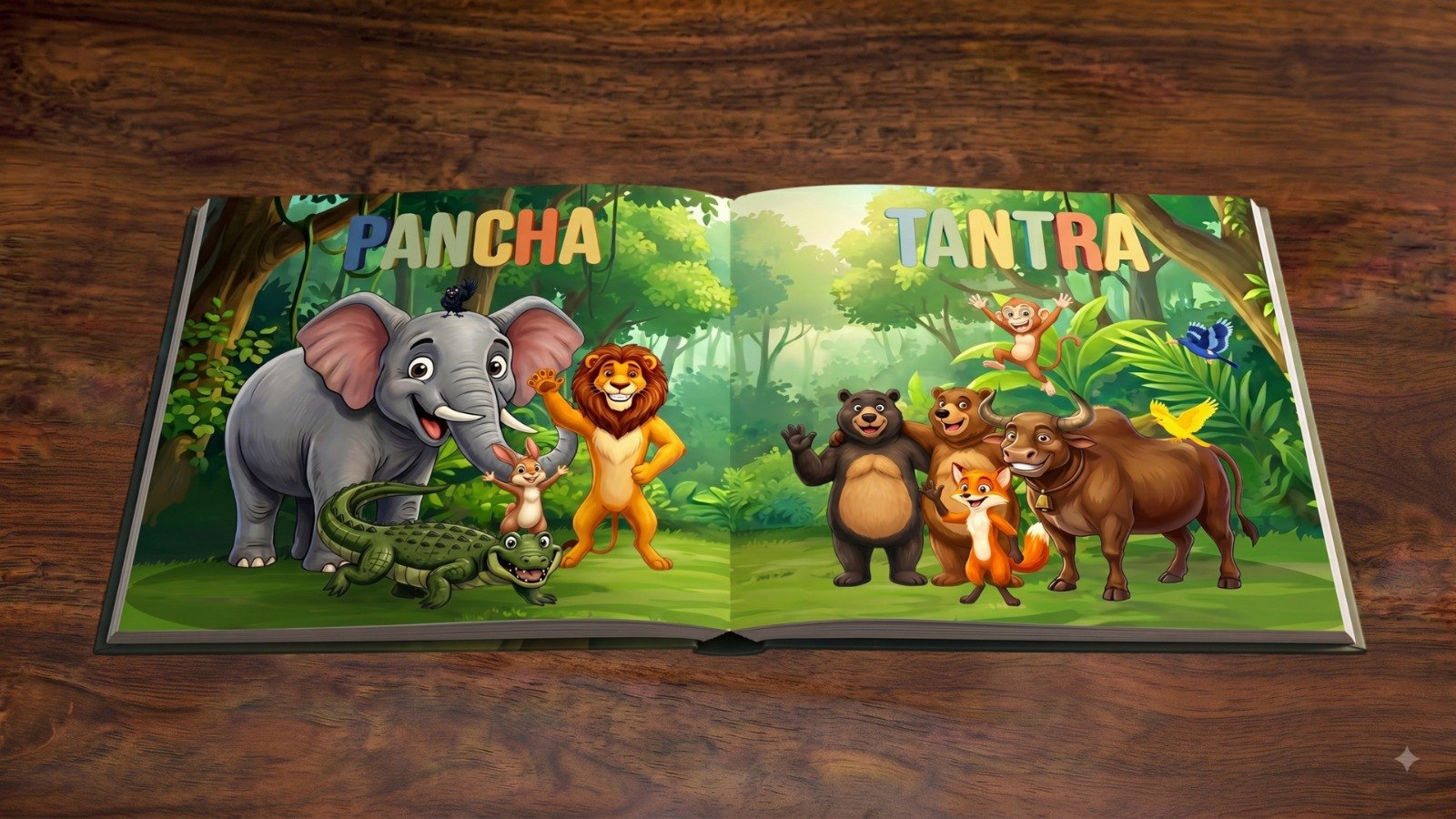
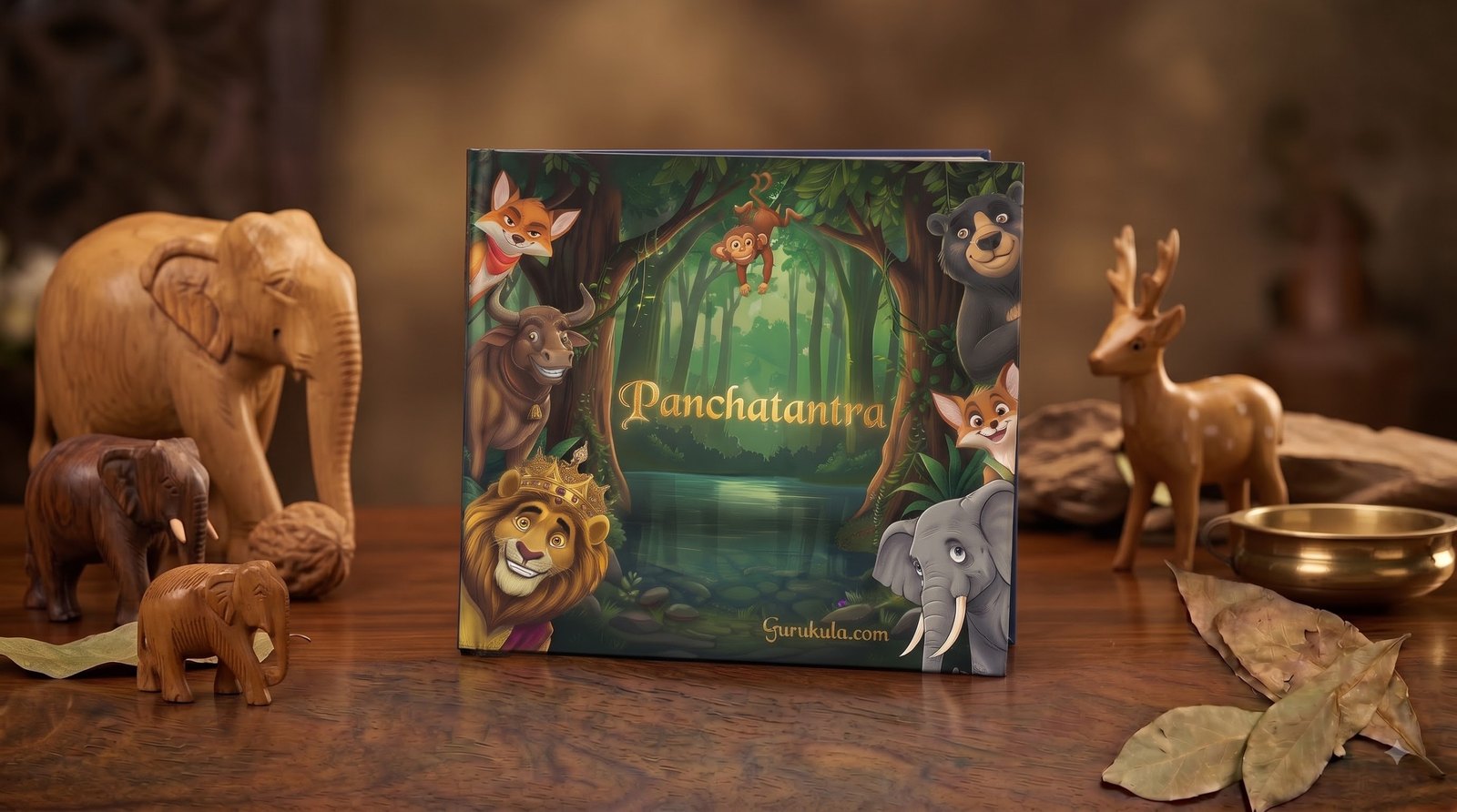
A printed storybook, illustrated and bound to be read on its own.
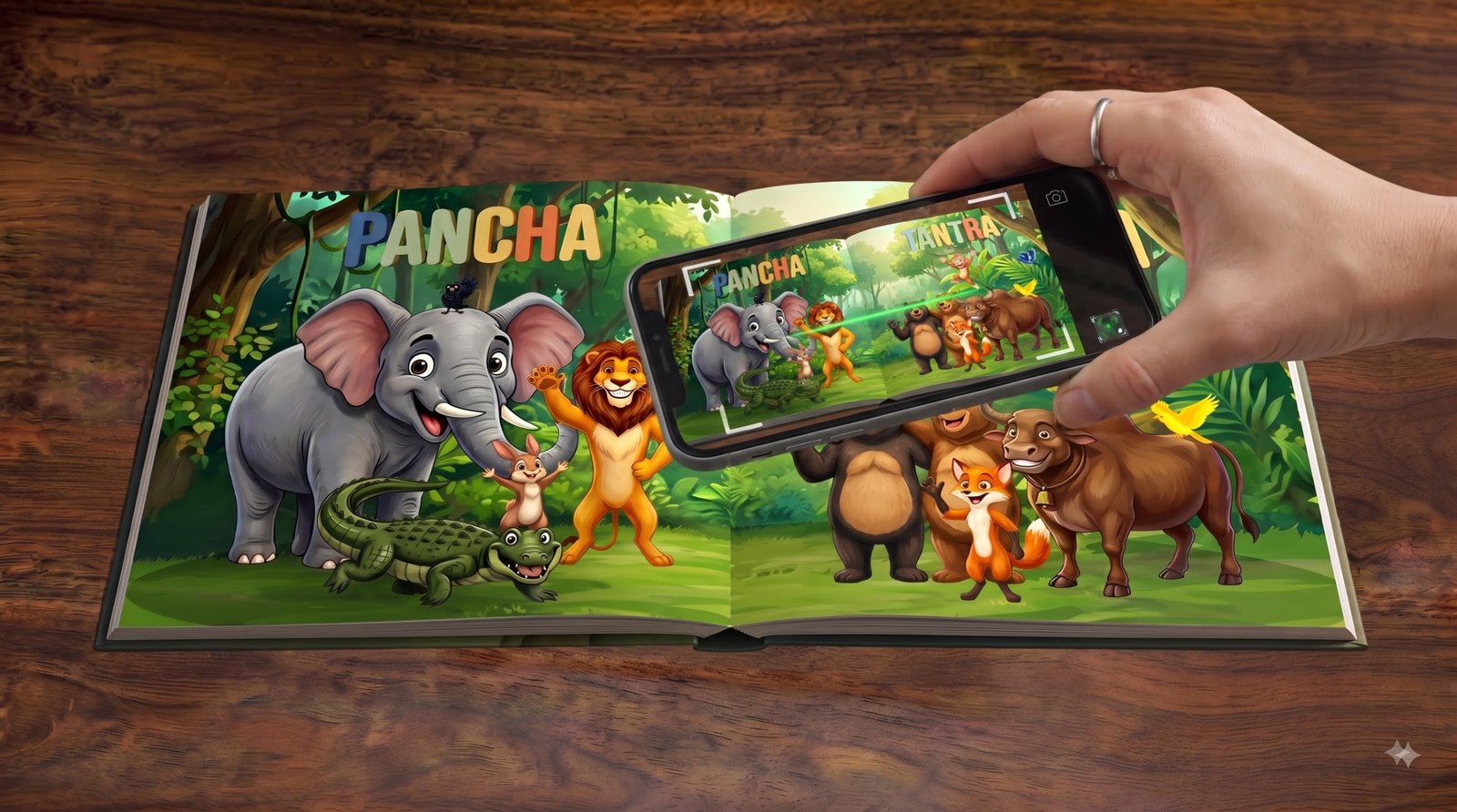
The page is recognised instantly. No markers, no codes to scan.
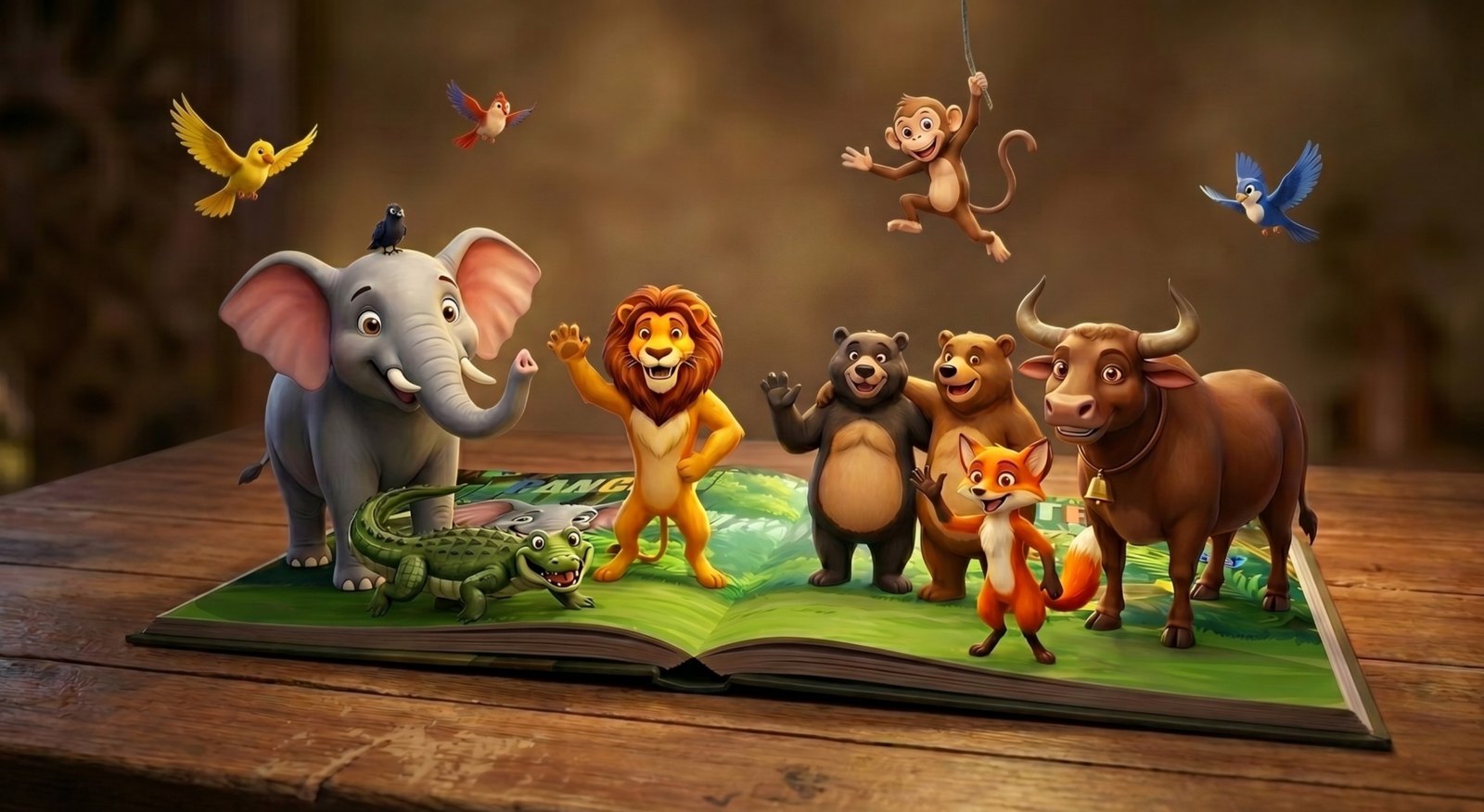
Characters rise off the paper into the room, at the scale of the table.
Characters react, choices carry consequences, the tale unfolds around the reader.
The book stays on the shelf. The experience is there whenever it is opened again.
Our catalog
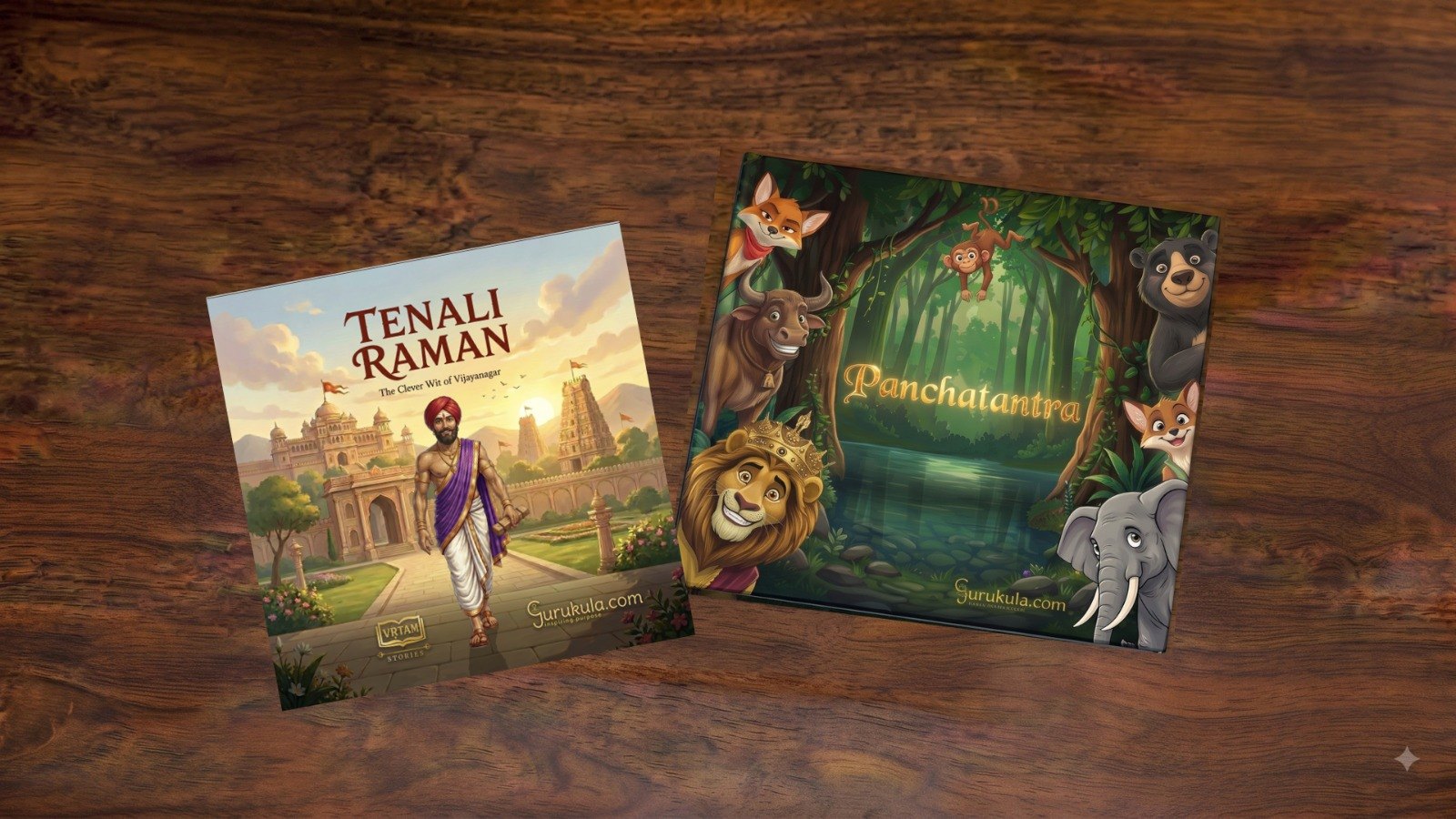
Pañcatantra and Tenali Rama, published under Vṛtam Stories.
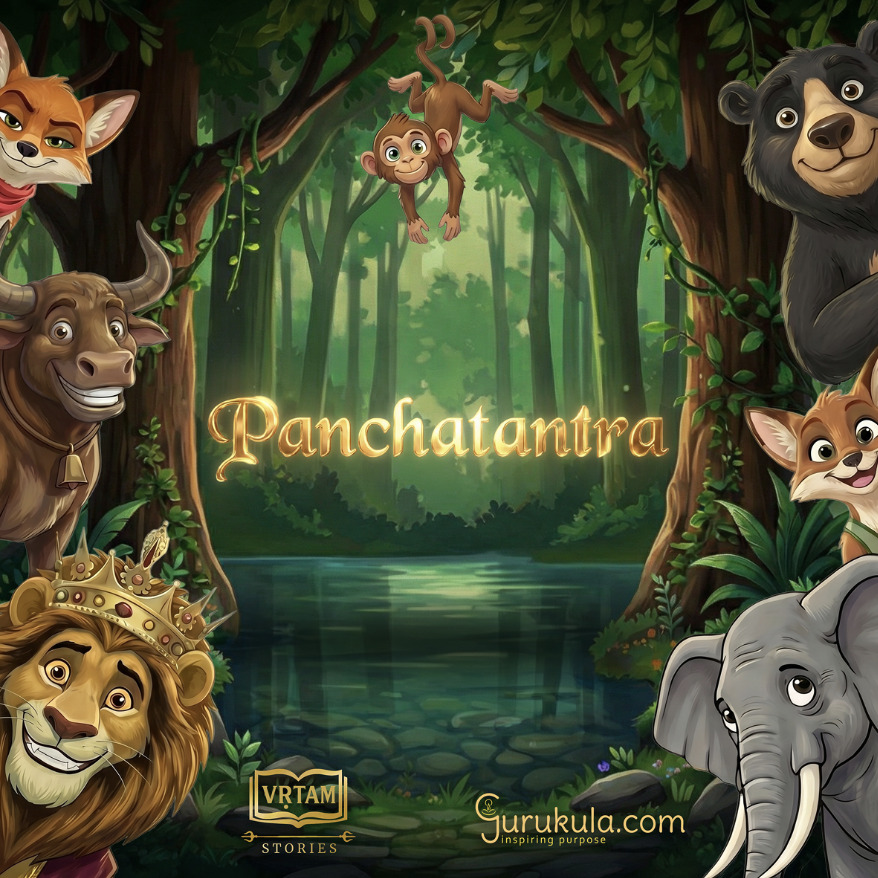
A beloved collection of animal fables that introduces children to wisdom, friendship, judgment and consequence through memorable characters and situations.
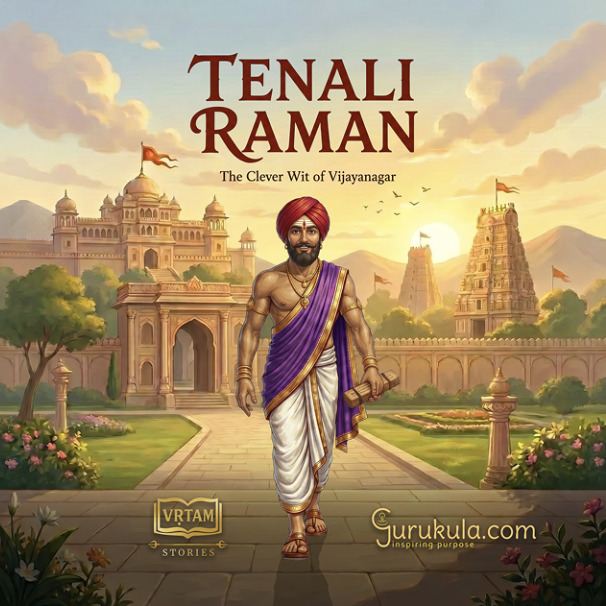
Stories of wit, humour and presence of mind from the Vijayanagara court, bringing Tenali Rama’s intelligence and charm into an interactive reading experience.
Related reading
Written over two thousand years ago, the Pañcatantra remains one of humanity's most enduring story collections. Here's why it resonates as powerfully today as it did then.
Augmented Reality is not just a visual novelty. It is a fundamentally new medium for storytelling. Here is how we are using it to resurrect the living tradition of Indian narrative.
Work with Vṛtam
We help institutions, publishers and cultural organisations translate stories, teachings and ideas into contemporary forms without losing their context.
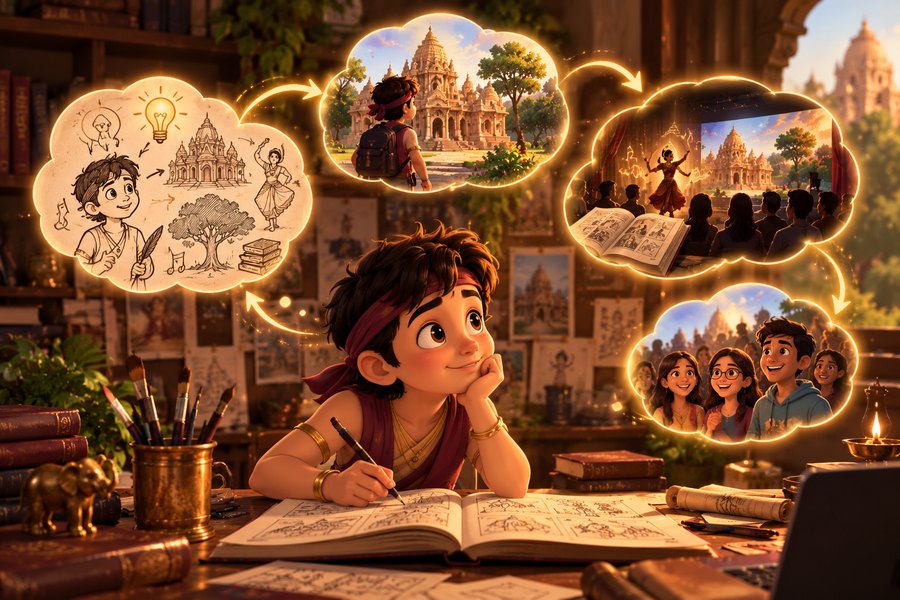
How we work
Every commission starts with the source and the setting, not with the technology.
Work with the text, the tradition and the scholars who hold it.
Decide what the audience should feel, and what form serves that.
Illustration, sound, 3D and motion, built in-house.
AR, VR or room-scale, engineered for the space it will live in.
Delivered, mapped and handed over to the people who will run it.
Work with Vṛtam
Explore Vṛtam Stories, join Kathakar, or step into Shiva Sannidhi in virtual reality.
Vṛtam Stories
Illustrated physical books enhanced with augmented reality through the Vṛtam app.
Animal fables about friendship, judgment, strategy and consequence, brought into an interactive reading experience.
Stories of wit, humour and presence of mind from the Vijayanagara court, designed for curious young readers and families.
Kathakar
Choose Kathakar for your own recurring sessions, or bring it to a larger organization, program or community.
For people hosting storytelling, teaching, workshops or cultural programs and building a recurring audience around their work.
For schools, cultural organizations and knowledge communities running recurring programs across multiple hosts, cohorts or audiences.
Vṛtam Experiences
A contemplative VR journey into a sacred Shiva environment, designed around atmosphere, presence and a sense of encounter.
Experiential pedagogy is the idea that the deepest learning happens not through instruction but through direct encounter. It has roots going back thousands of years, and modern neuroscience is finally catching up.
Long before the term "experiential learning" existed, the Gurukula system in ancient India was built entirely around it. A student did not sit in rows and receive information. They lived with their teacher, observed how wisdom manifested in daily decisions, participated in rituals, practised crafts, and engaged with stories as living conversations, not fixed texts.
The insight behind this system is simple: knowledge acquired through direct experience becomes part of who you are. Knowledge received passively remains on the surface, available for recall but disconnected from action.
The brain's learning architecture strongly favours experience over instruction. When we encounter something new through active engagement, through doing, seeing, feeling and choosing, multiple regions of the brain activate simultaneously: the hippocampus (memory formation), the amygdala (emotional encoding), the motor cortex (action simulation), the prefrontal cortex (meaning-making).
This multi-region activation creates stronger, more durable neural pathways. It also creates transfer: the ability to apply what was learned in one context to a different context. Passive learning rarely achieves transfer. Experience almost always does.
Contemporary education largely operates on an information-transfer model. A teacher possesses knowledge; students receive it. The efficiency of this model is appealing, since you can transmit a large volume of content in a fixed period, but the retention and application rates are remarkably poor.
Studies consistently show that students retain less than 10% of what they read and less than 20% of what they hear. But they retain over 75% of what they directly experience and practise.
Hermann Ebbinghaus's research in the 19th century identified what he called the "forgetting curve": the rapid decay of information that is learned but not reinforced through experience or application. Within 24 hours, we forget nearly 70% of new information. Within a week, over 90%.
Experience disrupts this curve because it creates episodic memory, memory tied to a specific event, place, or emotional state. Episodic memories are far more durable than semantic memories (facts and concepts learned in isolation).
Indian Knowledge Systems developed sophisticated frameworks for experiential learning long before modern educational theory. A few key concepts:
The Sanskrit concept of anubhava captures something specific: the kind of knowing that can only come through direct encounter. It is distinct from śravaṇa (hearing/receiving) and manana (reflection/reasoning). All three are considered necessary, but anubhava is the deepest.
Sustained practice in the presence of a skilled guide. The student does not just observe. They participate, make mistakes, correct, and gradually internalise the pattern. This is how music, dance, sculpture, and martial arts were transmitted across generations.
The use of narrative as a simulation of experience. A well-told story creates something close to anubhava: the listener inhabits another consciousness, faces a moral dilemma, feels the consequences of a choice. This is why the Pañcatantra and the Mahābhārata remain more alive than most textbooks: they are experience machines.
The emergence of immersive technologies, augmented reality, virtual reality and spatial computing, creates new possibilities for experiential pedagogy that were not available before.
For the first time, it becomes possible to create learning experiences that are:
This last point matters. Most educational technology is culturally neutral at best, and implicitly Western in its assumptions about learning, achievement, and value at worst. The opportunity to build immersive experiences rooted in the Dhārmic tradition, in the visual vocabulary of Indian temple art, in the narrative structures of Sanskrit literature, in the philosophical frameworks of the Upaniṣads, is something we take seriously at Vṛtam.
Every experience we create starts from a single question: what do we want the learner to feel?
Not what do we want them to know. Not what do we want them to remember. What do we want them to feel: in their body, in their moral intuition, in their sense of identity and belonging.
The knowledge follows from the feeling. The retention follows from the embodiment. The wisdom follows from the experience.
That is experiential pedagogy. That is what we are building.
Work with Vṛtam
Written over two thousand years ago, the Pañcatantra remains one of humanity's most enduring story collections. Here's why it resonates as powerfully today as it did then.
The Pañcatantra is not a relic. It is a living system, a carefully constructed framework for transmitting wisdom across generations. Composed by the scholar Viṣṇu Śarma around 300 BCE, it was designed explicitly as a teaching tool: to impart the principles of nīti (wise conduct) to young princes through stories involving animals, kings, and merchants.
What made it revolutionary then, and what keeps it relevant now, is its method. Rather than issuing commandments or abstract principles, the Pañcatantra embeds moral intelligence inside narrative. The lessons are inseparable from the stories. You cannot extract the wisdom without losing it.
Neuroscience has now confirmed what ancient Indian educators knew intuitively: stories activate the brain in ways that declarative statements cannot. When we hear a story, our sensory cortices light up. We simulate the experience. We feel the fear of the crow outsmarted by the snake, the regret of the monkey who trusted too quickly.
This is exactly why the Pañcatantra survived. It was translated into Persian in the 6th century CE, into Arabic as Kalīla wa Dimna, into Hebrew, into Latin, eventually into nearly every major world language. Each translation adapted the surface, but the deep structure held. Story is the most portable container for wisdom ever invented.
The word Pañcatantra means "five treatises" or "five strategies." Each of the five books addresses a different dimension of practical wisdom:
How relationships are corrupted by self-interest and manipulation. The iconic story of the lion Piṅgalaka and the bull Sañjīvaka, separated by the scheming jackal Damanaka, is a masterclass in how trust is destroyed.
How alliances are formed across difference. The crow, mouse, tortoise, and deer become unlikely companions through mutual aid. Their friendship survives precisely because each member contributes a different strength.
On the nature of long-standing conflict and the limits of diplomacy. Some enmities cannot be resolved. They can only be navigated with intelligence.
On foolishness and greed. The gains you win through cleverness can be undone in an instant by a moment of vanity or impatience.
The danger of acting without investigation. Haste, assumption, and incomplete information lead to irreversible tragedy.
The Pañcatantra works on children the same way it worked on ancient princes: not through instruction, but through absorption. A child who hears about the monkey and the crocodile does not come away thinking "I have learned that betrayal destroys friendship." They come away with an embodied sense of how that betrayal felt, and why the friendship was worth protecting.
This is dhārmic pedagogy at its core. You do not teach the principle. You create the experience that makes the principle self-evident.
At Vṛtam Studios, we started with the Pañcatantra because it represents the clearest case for immersive storytelling within the Indian Knowledge System.
The stories were always meant to be multi-sensory. They were performed, illustrated, sung. The text was the substrate. The experience was the point.
Augmented Reality gives us a new substrate. When a child holds up their phone and watches Damanaka the jackal walk toward them, whispering his manipulations into the ear of the lion king, something shifts. The story becomes present. The wisdom becomes embodied.
Two thousand years on, the Pañcatantra is still doing what it was designed to do.
Work with Vṛtam
Tap a book, pay by card, and it's yours.
Order — show this to the person at the stall.
Checkout
Your cart is empty.
Browse the shop →Order . A confirmation email is on its way to .
Continue browsing →VRTAM Studios is committed to protecting the personal information of our customers and users. This Privacy Policy describes our practices regarding data collection, use, storage, and disclosure in connection with our website (vrtam.in), physical products, and the VRTAM AR application.
Our mobile application is designed with privacy as a priority. When you use the app, we collect exactly three items, all strictly for core app functionality:
Camera and AR Functionality: The app requests camera access solely for on-device Augmented Reality (AR) marker tracking of printed book pages. All camera imagery is processed locally on your device by the AR engine. We do not record, store, or transmit any images or video data from your camera.
We do not collect names, email addresses, physical addresses, dates of birth, age, photographs, location data, contacts, or any advertising identifiers within the AR application.
We do not sell your personal information. We do not share data for advertising or analytics. We share data only with a strictly limited number of service providers solely to operate our app and website:
Personal data is retained only as long as necessary for the purposes described in this policy. Order data is retained for a minimum of 7 years for tax and accounting purposes. Early access data is retained until you opt out or submit a deletion request.
Our website (vrtam.in) uses cookies to improve your experience. The AR app does not use cookies.
Cookie preferences can be managed via your browser settings at any time.
The VRTAM AR application contains no third-party analytics SDKs, no crash-reporting SDKs, and no advertising SDKs. We do not track screen views or events, and we do not use Google Analytics for Firebase. We do not show ads, and we do not track you across apps or websites owned by other companies.
While our augmented reality books are meant to be enjoyed by families, the AR application requires a parent or guardian to sign in. All account authentication is directed explicitly at adults. We intentionally do not collect personal information directly from children, nor do we build child profiles. Any links out of the app or paths to our website are protected by a parental gate.
We employ SSL encryption, secure database storage, and access controls to protect your data. However, no method of transmission over the internet is 100% secure.
To exercise any of these rights, contact us at [email protected].
Updates to this Privacy Policy will be posted on our website with a revised effective date. Continued use of our services after changes constitutes acceptance of the updated policy.
These Terms and Conditions govern your use of vrtam.in, the VRTAM Panchatantra AR Storybook application, physical products, and related services offered by VRTAM Studios. By accessing our website or making a purchase, you agree to be bound by these Terms.
Our services are intended for users of all ages. However, purchases must be made by individuals who are 18 years of age or older, or by a parent or legal guardian on behalf of a minor.
We offer AR storybooks including the Panchatantra AR Storybook, subject to availability and applicable shipping timelines.
The companion AR application is available on the Google Play Store. Certain AR experiences require the physical storybook. The application is licensed for personal, non-commercial use only.
Pre-orders are advance purchases made before official product launch. Estimated delivery timelines are communicated at the time of purchase and are subject to change.
Early access sign-ups provide priority notification and exclusive discounts. Sign-up does not constitute a purchase or guarantee of product availability.
All prices are in Indian Rupees (INR) and inclusive of applicable taxes where indicated. Payments are processed via Razorpay and may be made by UPI, credit/debit card, net banking, or digital wallets. Full payment is required at the time of purchase. In the event of a pricing error, VRTAM Studios reserves the right to cancel the affected order and issue a full refund.
All content on this website and within our products — including text, graphics, characters, illustrations, animations, logos, and the VRTAM Studios brand identity — is the exclusive intellectual property of VRTAM Studios or its licensors. "Experiential Pedagogy" is a trademark of VRTAM Studios. Unauthorized reproduction, distribution, or use of any content is strictly prohibited.
By using our website and products, you agree not to:
Use of the AR application is also subject to Google Play's Terms of Service. Additionally:
VRTAM Studios shall not be liable for any indirect, incidental, special, or consequential damages arising from your use of our products or services. Our total liability shall not exceed the amount paid by you for the specific product or service giving rise to the claim.
In the event of a dispute, please contact us first at [email protected]. We aim to resolve all disputes within 14 business days. Any unresolved disputes shall be subject to the exclusive jurisdiction of the courts of Bengaluru, Karnataka, India, and governed by the laws of India.
VRTAM Studios reserves the right to update these Terms at any time. Continued use of our website or services following any changes constitutes your acceptance of the revised Terms.
VRTAM Studios is committed to customer satisfaction. This policy covers refunds and cancellations for physical products, digital products, and application purchases.
Returns are accepted within 7 days of receiving your order, provided:
If your product arrives defective or damaged, please contact us within 48 hours of delivery with photographs of the damage. We will arrange a replacement or issue a full refund at no cost to you.
Full refund to your original payment method, processed within 7–10 business days.
Standard return conditions as described in Section 2 apply.
If VRTAM Studios is unable to fulfill your pre-order within 90 days of the estimated delivery date, you will be offered a full refund or the option to continue waiting for fulfillment.
Once a digital product has been downloaded, refunds are generally not available. Exceptions apply if the application fails to function on a supported device despite reasonable troubleshooting, or in the case of a billing error.
Early access deposits are fully refundable until the official product launch date. After launch, the deposit amount will be applied toward your purchase price.
Refunds are processed to the original payment method used at the time of purchase.
Email [email protected] with the subject line "Refund Request - [Order Number]". Please include your order number, reason for the request, and photographs if applicable. Our team will respond within 3 business days.
VRTAM Studios ships physical products across India and to select international destinations.
Orders are processed within 2–3 business days of payment confirmation. Pre-orders are dispatched as per the communicated launch timeline. Orders placed on weekends or public holidays are processed on the next business day.
We ship via Delhivery, BlueDart, and India Post.
We currently ship internationally to the UAE, USA, UK, Canada, Singapore, and Australia.
Timelines may vary due to customs processing and local courier conditions.
Shipping fees are calculated at checkout based on destination and package weight. The customer is responsible for any applicable customs duties and import taxes levied by the destination country.
A tracking number will be shared via email once your order has been dispatched. VRTAM Studios is not responsible for delays caused by courier services or customs processing.
Our courier partners will make 2–3 delivery attempts. If delivery is unsuccessful after all attempts, the package may be returned to us. Re-delivery charges may apply for reshipping.
If your order has not arrived by the expected delivery date or arrives damaged, please contact us within 48 hours of the expected delivery date. Please retain the original packaging for any damage claims, as it may be required by the courier.
VRTAM Studios is not responsible for delivery delays or failures resulting from an incorrect or incomplete shipping address provided at checkout. Please review your address carefully before placing your order.
Pre-orders are dispatched as per the estimated product launch date communicated at the time of purchase. An email notification with your tracking number will be sent at the time of dispatch.